Author: creditveto

  • Is a 609 Credit Score Bad or Just Misunderstood?

    Is a 609 Credit Score Bad or Just Misunderstood?
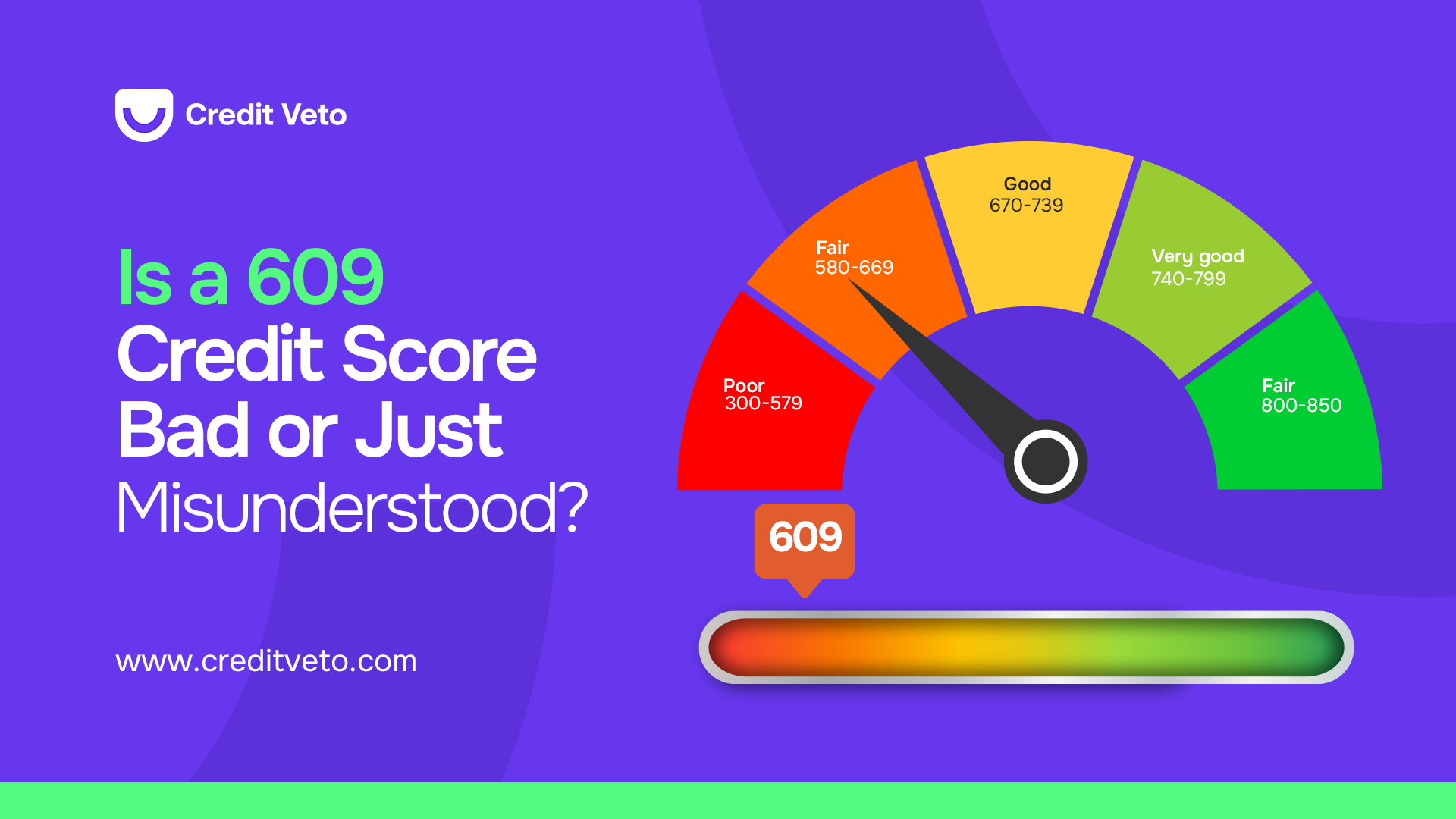
    Short Answer: A 609 credit score isn’t great, but it’s not necessarily bad either. It falls into the fair range, meaning there’s room for improvement, but it’s not a dealbreaker when it comes to things like loans or credit cards.

    If you’ve ever pulled your credit report and seen a 609 credit score staring back at you, you’re not alone. It’s the kind of score that sits in that uncomfortable middle ground. 

    Not quite bad, but definitely not great either. So the big question is: Is a credit score of 609 good, or are you in trouble? Let’s break this down honestly and give you the clarity most articles don’t.

    What Does a 609 Credit Score Really Mean?

    A credit score chart by FICO showing where a 609 credit score falls under a category

    A 609 credit score sits in the “fair” range on the FICO scale, which spans from 300 to 850. It’s not considered a bad score outright, but it definitely signals to queen lenders that you may have had some financial hiccups like missed payments, high utilization, or possibly collections. 

    If you’re asking, “Is a credit score of 609 good?” The answer depends on your goals. For premium credit cards or low-interest mortgage rates, it’s not ideal. But it’s not the worst either.

    Most lenders see a 609 credit score as a financial yellow light,not a full stop, but not a green light either. You’re still able to qualify for credit products, but usually under less favorable terms. This includes higher interest rates, lower approval limits, and sometimes additional requirements like a cosigner or security deposit.

    So, is a 609 credit score bad? Not exactly. It’s more of a warning that your credit profile needs improvement (and fast)if you want to access better financial opportunities. This is where many blogs stop short, but here’s what most don’t tell you:

    • A 609 score often contains outdated or fixable negative items such as collections, old inquiries, or incorrect account details. These can be disputed and possibly removed.
    • Many consumers stay stuck at 609 simply because they don’t know which credit behaviors matter most. Knowing how to prioritize your actions, like focusing on utilization and removing errors, can push you above 640 in a few weeks.

    Bottom line? A 609 credit score is not your final destination. With the right strategies and tools, you can rebuild your credit and escape the high-interest trap that most “fair credit” borrowers fall into.

    Read Also: 6 Best Ways to Remove Paid Collections from Your Credit Report

    Is a 609 Credit Score Bad? Or Just Misunderstood?

    A curious lady with a credit card in one hand and phone in the other wondering what a 609 credit score is good or bad

    This is where most articles miss the mark. Some sugarcoat it. Others lean heavily on fear. But the truth is this; a 609 credit score is not excellent, yet it’s far from hopeless. What people really need to hear is that it’s not just about the number. It’s about why the number exists.

    So, is 609 credit score bad? Technically, it falls into the fair category, which means it’s below average but not dangerous. You might not get premium credit cards or the best loan rates, but you’re not locked out of financial opportunities either.

    In reality, many people land at a 609 credit score because of things like:

    • Old or unpaid medical bills
    • High balances on revolving credit cards
    • One or two late payments
    • No credit history at all, especially for immigrants, young adults, or people who avoided debt entirely

    Most of these issues aren’t rooted in recklessness. They stem from a lack of credit education, missed notices, or financial emergencies. That’s why calling a 609 credit score “bad” is misleading. What you actually need is the right roadmap, not more shame or confusion.

    And this is where you have an edge. If you take action early, a 609 credit score can be turned around in less time than you think. Unlike the articles that simply label it fair or poor, we’re showing you how to move forward with clarity and strategy.

    Why Your Credit Score Matters More in 2025 Than Ever

    a handing checking their credit score on the phone

    In 2025, a 609 credit score matters more than it ever did. Lenders are no longer just looking at your score, they’re analyzing your entire credit behavior with AI-driven tools and deeper data models. So even if your credit score lands in the “fair” range, you’re being evaluated far beyond just the number.

    Is a credit score of 609 good enough today? Not quite. It’s still considered fair, but in today’s stricter lending environment, that often means higher costs and fewer options.

    Here’s what a 609 credit score could mean for you right now:

    • You might miss out on competitive mortgage interest rates, which could cost you tens of thousands over the life of a loan
    • Auto loan lenders may approve you, but with significantly higher interest rates
    • You may be required to pay upfront deposits when renting an apartment or setting up utilities

    And here’s the part many people overlook: AI-powered underwriting tools now weigh patterns, not just points. This means that having a 609 credit score (even if it’s stable) can still be flagged if lenders see high utilization, late payments, or inconsistent activity.

    So if you’re asking is 609 credit score bad, the answer depends on what you plan to do with your credit. But one thing is clear: fixing and improving that score is more urgent now than ever.

    See Also: Default Credit Score: The Surprising Truth & Alternative Scores

    609 Credit Score: What You Can Still Do

    If you have a 609 credit score, don’t assume your options are gone. While it’s not the strongest score, it’s still workable. What matters is knowing where to start.

    So, is a credit score of 609 good? Not exactly. But it’s not the end either.

    Here are smart ways to start rebuilding and still access credit:

    • Secured credit cards: These require a refundable deposit and help build positive credit history
    • Unsecured cards with low limits: Some lenders will approve you for a card with a higher interest rate or smaller credit line
    • Credit builder loans: These are designed to improve your score through structured, manageable payments
    • Rent and utility reporting: Use tools that add rent, phone, or utility payments to your credit file to boost your history

    These steps are often overlooked in generic advice, but they are proven to work. Having a 609 credit score doesn’t make you irresponsible. It usually means you’ve had a setback or lacked guidance. The good news is, you can move up the right approach.

    The Fastest Way to Improve a 609 Credit Score

    If you have a 609 credit score, you’re not alone. Many people are in this range and often ask, “Is a 609 credit score bad?” The truth is, it’s not ideal, but it’s fixable. The key is knowing exactly where to start.

    Here are five proven steps to improve your score fast.

    1. Check Your Credit Report for Errors

    Start by reviewing your reports from Experian, Equifax, and TransUnion. One in five reports contains errors that could be dragging your score down. These mistakes might include outdated accounts, incorrect balances, or wrongly reported late payments.

    Disputing and correcting even a single error could give your score a boost of 30 points or more.

    2. Lower Your Credit Card Utilization

    Your utilization rate is how much of your credit you’re using. For example, if your card limit is $1,000 and your balance is $800, your utilization is 80 percent, which hurts your score.

    Keep it below 30 percent, and ideally under 10 percent, to see real improvements.

    3. Add New Positive Accounts

    To balance out past negatives, add new positives. Use tools that report rent, utility payments, or streaming service subscriptions to credit bureaus. You can also apply for a credit builder loan or secured credit card to build a better history.

    4. Request a Credit Limit Increase

    Call your credit card provider and ask for a limit increase. If approved, your credit utilization improves without you needing to open a new account. Just make sure not to increase your spending along with the new limit.

    5. Dispute Unverifiable or Outdated Items Legally

    If you have old collections or questionable accounts, you may be able to dispute them under the Fair Credit Reporting Act (FCRA).

    Use personalized letters, not generic templates, and challenge items that cannot be verified or are beyond the legal reporting limit. This approach works best when done carefully and within legal guidelines.

    The Problem With Most Advice Online

    We analyzed the top-ranking blogs for the keyword 609 credit score as well as social media posts. And while they explain the basics, they often fall short where it really counts.

    Most of these articles:

    • Gloss over practical next steps you can take right now
    • Avoid talking about real-life credit challenges, like living on a low income or having no credit history at all
    • Skip over legal loopholes you’re actually allowed to use to fix your credit

    One key strategy that rarely gets a proper breakdown is the 609 dispute letter method. It’s based on Section 609 of the Fair Credit Reporting Act, which gives you the right to request full details about items on your report.

    Here’s the truth: the 609 letter isn’t a magical fix, but when written correctly and used strategically, it can trigger investigations that lead to outdated or unverified accounts being removed.

    The secret is personalization. Don’t use copy-and-paste templates from the internet. Write your letters in your own words. Include specific details. And always follow up with the credit bureaus.

    So… Is a Credit Score of 609 Good?

    In simple terms: no, a 609 credit score is not considered good but it’s also not bad enough to stop your progress.

    Think of it as a warning light, not a closed door. It means there’s work to do, but the path forward is still wide open. With the right credit habits, many people can:

    • Move from 609 to 650+ within a month or two
    • Reach 700 or higher in three to six months
    • Start qualifying for lower interest rates, better credit cards, and stronger loan options

    If you’ve been asking if a credit score of 609 bad or good bad, the real answer lies in what you do next. The number doesn’t define you; your next steps do.

    Don’t just scroll through advice. Pick one action today. Then follow it with another tomorrow. That’s how credit improvement happens.

    Final Thoughts

    Whether you searched for things like “ is 609 credit score bad” or just finished checking your report, remember this; your 609 credit score isn’t the end. It’s a snapshot, not a life sentence.

    That number might feel like a wall right now, but it’s really a window. A window into better habits, smarter credit decisions, and real opportunities waiting to be unlocked.

    At Credit Veto, we don’t just teach you what to do; we give you the templates, tools, and guided systems to actually do it. From disputing errors legally to building positive credit history, we help everyday people go from 609 to 720 and beyond, without guessing or falling into common traps.

    If you’re serious about turning that score around, and also discover how you can help people do same and earn from it, Start with Credit Veto Pro. Your future self will thank you.

    FAQs (People Also Ask)

    How long does it take to improve a 609 credit score ?

    With Credit Veto’s tailored strategies, you can start seeing improvements in your score within a few months. Our proven methods for credit repair can help remove inaccuracies and strengthen your credit profile, potentially raising your score above 609.

    What steps can I take to improve my 609 credit score using Credit Veto?

    Credit Veto helps you identify the specific issues holding your score back. Whether it’s late payments, high balances, or inaccurate information, we provide you with the tools and guidance to address them. Our step-by-step process can help raise your score and improve your financial outlook.

    What steps can I take to improve my 609 credit score using Credit Veto?

    Credit Veto helps you identify the specific issues holding your score back. Whether it’s late payments, high balances, or inaccurate information, we provide you with the tools and guidance to address them. Our step-by-step process can help raise your score and improve your financial outlook.

  • Hard Inquiry vs Soft Inquiry: The Real Difference That Can Save or Sink Your Credit Score Fast

    Hard Inquiry vs Soft Inquiry: The Real Difference That Can Save or Sink Your Credit Score Fast
    Short Answer: A hard inquiry happens when a lender checks your credit for a loan or credit card. It can lower your score slightly for a short time. A soft inquiry happens when you or a company checks your credit for background reasons, and it never affects your score.

    Most people in the U.S. believe that every time someone checks their credit, their default credit score drops. That’s not true.

    The truth is that credit checks come in two types (hard and soft), and they affect your score very differently.

    Many Americans lose points on their credit report because they don’t understand how these checks work. Others avoid checking their credit altogether because they fear a score drop. 

    But once you understand how hard inquiry vs soft inquiry really works, you’ll stop fearing your credit report and start using it as a tool to build wealth.

    Let’s break it down in simple terms.

    What Is a Credit Inquiry?

    A curious lady with a credit card in one hand and phone in the other wondering what a credit inquiry is and the difference between hard inquiry and soft inquiry

    A credit inquiry is a request to look at your credit report. Your credit report is like a personal history file that shows how you’ve handled loans, cards, and payments.

    It helps lenders decide if they can trust you with money. Every time a lender, employer, or even you checks your credit, that action is logged as an inquiry.

    But here’s what most people miss: not all inquiries are treated equally. Some inquiries tell lenders, “This person is shopping for money,” while others simply say, “This person is checking information.”

    That is the difference between a soft and a hard credit check.

    Examples of Hard vs Soft Inquiry

    Image illustrating examples of hard  inquiry and soft inquiry.

    Now, let’s understand what a hard and soft credit inquiry is with some examples.

    What Is a Hard Inquiry?

    A hard inquiry happens when you apply for something that involves borrowing money. This could be a credit card, a mortgage, a car loan, or a personal loan.

    A lender checks your credit report to decide whether to approve you. Because they are making a financial decision, the credit bureau records it as a hard pull.

    Each hard inquiry can lower your credit score by around two to five points.

    It’s not much, but if you apply for many loans or cards in a short period, the drops can add up. A hard inquiry stays on your credit report for two years, but it only affects your score for about twelve months.

    Example:

    • If you apply for a car loan today, the bank runs a hard inquiry.
    • If you apply for three credit cards next week, that’s three more hard inquiries.

    The scoring model might see that as risky behavior, like someone short on cash. But if you space out your applications, the impact is small and temporary.

    Hard inquiries aren’t bad. They’re just signs that you’re using credit. The key is to manage how often they happen.

    What Is a Soft Inquiry?

    A soft inquiry is a credit check that does not affect your score. It happens when you check your own credit or when a company does a background or pre-approval check that doesn’t involve a lending decision.

    Examples of soft inquiries include:

    • Checking your score through credit repair apps and AI-powered systems like that as Credit Veto.
    • Getting pre-approved for a loan or card.
    • A potential employer is checking your report as part of a background review.
    • Insurance companies running risk checks before offering coverage.

    Soft inquiries show up on your personal credit report, but only you can see them. Lenders cannot. That means you can check your score every day if you want to, and your credit will stay the same.

    Hard vs Soft Credit Pull: The Real Difference

    The biggest difference between a hard and soft credit pull is how they affect your score.

    A hard credit pull tells scoring systems that you’re seeking new credit.

    A soft pull is just for information, not money.

    Here’s a quick way to remember it:

    TypeWho Requests ItPurposeVisible to LendersAffects Score
    Hard InquiryLenderCredit applicationYesYes
    Soft InquiryYou or the companyBackground check or pre-approvalNoNo

    If you’re checking your own score, it’s always a soft credit pull.

    If a bank is checking your score to approve a loan, it’s a hard pull.

    It’s that simple.

    Why Many People Get This Wrong

    A lot of people avoid checking their credit out of fear. They think that every look at their report will damage their score. That’s why misinformation spreads. But ignoring your credit is actually worse. You can’t fix what you don’t see.

    Checking your credit score regularly is one of the best ways to stay alert for fraud or errors. Soft checks are your friend. They help you see where you stand without hurting your score.

    The real problem is not checking your credit; it’s applying for too many loans too quickly.

    The Hidden Impact on Lenders and Borrowers

    Lenders use both types of inquiries differently. When they run a hard inquiry, they’re judging your risk. When they run a soft one, they’re screening you as a potential customer.

    For example, when you get those “You’re pre-approved!” credit card offers in the mail, that’s based on a soft pull. The company reviewed your report lightly to see if you fit their requirements.

    When you respond to that offer and apply, it turns into a hard inquiry. So one inquiry can actually turn from soft to hard depending on your next action.

    The Shopping Window Secret

    Here’s something the credit bureaus don’t always make clear. If you apply for several car loans or mortgages within a short period, the system treats those multiple inquiries as one.

    Why?

    Because it assumes you’re shopping for the best rate, not desperate for credit. This window is usually 14 to 45 days long, depending on the scoring model.

    So if you’re comparing mortgage rates from three banks in two weeks, that counts as one hard inquiry.

    Smart borrowers use this rule to their advantage. It lets you shop around without damaging your score.

    How to Handle Hard Inquiries Without Hurting Your Score

    Infographics showing how to dispute fraudulent hard inquiries

    Here are the top 5 key strategies you can use to handle a hard inquiry affecting your credit score.

    1. Plan before applying.

      Only apply for credit when you truly need it. Don’t fill out every pre-approval you see.
    2. Space out your applications.

      Give at least three to six months between major applications.
    3. Monitor your credit reports often.

      Check for unauthorized inquiries. You can get free reports from annualcreditreport.com or use systems like Credit Veto.
    4. Dispute any inquiry you didn’t approve.

      Unauthorized hard inquiries can be removed by contacting the credit bureau or working with a credit repair company like Credit Veto.
    5. Build a strong payment history.

      A few hard inquiries won’t hurt if you consistently pay on time and keep low balances.

    Remember, lenders look at your full profile, not just one score drop.

    Why This Knowledge Matters

    A single misunderstanding about credit checks can cost you real money. People with strong scores get better loan rates, lower interest rates, and higher limits.

    People with weak scores pay more for the same things: cars, apartments, phones, and insurance. The difference between a soft and hard credit check could mean saving hundreds or losing them.

    For instance, someone with a 760 score might get a 5% rate on a car loan, while someone at a 680 score pays 8%. That small gap costs thousands over the life of the loan.

    Understanding how inquiries work helps you stay in control of your credit journey.

    Common Myths About Hard and Soft Inquiries

    1. Every credit check lowers my score.

    False. Only hard inquiries can lower your score.

    1. I shouldn’t check my score often.

    False. Checking your score through a soft pull keeps you informed and safe.

    1. Hard inquiries ruin your credit.

    False. The impact is small and temporary unless you apply for many accounts at once.

    1. You can’t remove hard inquiries.

    False. If a company checked your credit without consent, it can be disputed and removed.

    1. Soft inquiries don’t matter.

    False. While they don’t affect your score, they help you catch identity theft and monitor your credit growth.

    The Emotional Side of Bad Credit

    Building credit can be stressful. Many people feel judged by a number they don’t fully understand. But your credit score isn’t a report card on your worth.

    It’s simply a measure of financial behavior that can change over time. Every good payment, every low balance, and every responsible move adds up.

    Knowing how hard inquiry vs soft inquiry works gives you control again. You’re not at the mercy of lenders. You can plan, build your credit, grow smarter, and even start helping others do the same and earn from it.

    Read Also: How to Become a Certified Credit Repair Specialist in 2025 (Even If You’re Starting from Scratch)

    Conclusion

    The difference between a soft and hard credit check is small in definition but huge in impact. Soft inquiries are safe and help you stay informed.

    Hard inquiries matter only when they pile up. If you’ve been rejected for credit or notice too many hard inquiries on your report, don’t panic.

    At Credit Veto, we help U.S. residents remove unauthorized inquiries, fix reporting errors, and build healthy credit that lenders respect. Sign up with us today to be among the elite with exceptionally good credit.

    Your credit report should be your advantage, not your barrier. Start cleaning up your report with us and start building the score you deserve.

    Frequently Asked Questions (FAQs)

    Do soft inquiries show up on my credit report?

    Yes, but only you can see them. Lenders cannot.

    How long do hard inquiries stay on my report?

    They remain for two years but affect your score for only about twelve months.

    How many points can a hard inquiry lower my score?

    Usually between two and five points, depending on your current credit standing.

    Can I remove a hard inquiry from my report?

    Yes, if it was unauthorized. Contact the credit bureaus or reach out to Credit Veto for help.

    Are soft credit checks safe?

    Yes. They never harm your score and help you monitor your report safely.

    Is it okay to have multiple hard inquiries?

    Yes, if they are spread out or related to rate shopping for one type of loan.

    What is the fastest way to recover from multiple hard inquiries?

    Keep your balances low, pay bills on time, and avoid applying for new credit for a few months.

    What is the difference between hard inquiry and soft inquiry?

    A hard inquiry happens when you apply for credit and can lower your score slightly. A soft inquiry happens for background checks and does not affect your score.

    What is an example of a hard inquiry?

    Applying for a car loan, mortgage, or credit card.

    What is an example of a soft inquiry?

    Checking your own credit score on Credit Karma or getting pre-approved for a loan offer.

    Does a hard inquiry mean I got approved?

    No. It only means the lender reviewed your report. Approval depends on their decision after reviewing your credit.