Blog

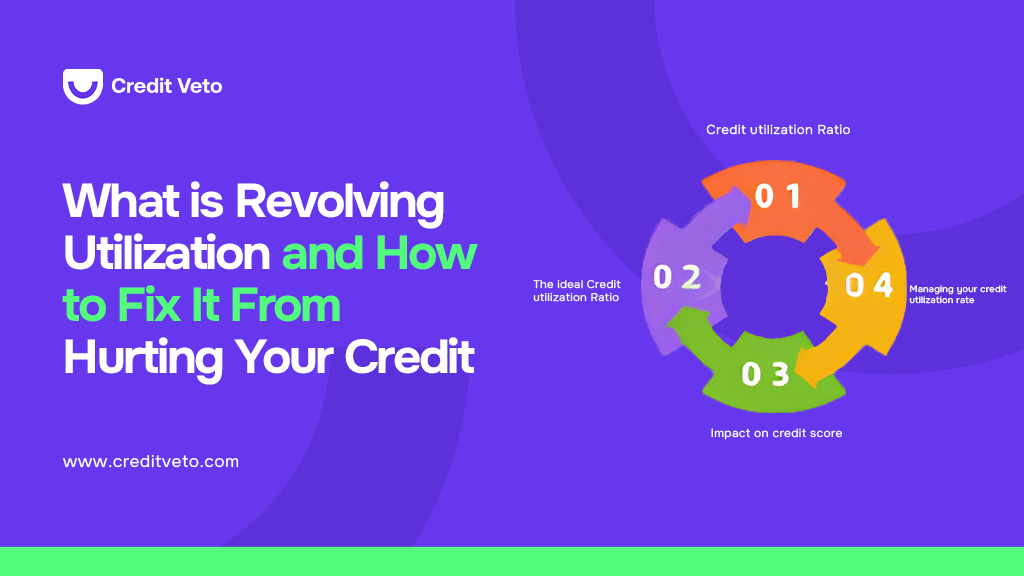
  • What is Revolving Utilization and How to Fix It From Hurting Your Credit

    What is Revolving Utilization and How to Fix It From Hurting Your Credit

    Short Answer: Revolving utilization refers to the percentage of your available credit that you’re currently using. High utilization can negatively impact your credit score, making it harder to qualify for loans or secure favorable interest rates. To improve your credit score, aim to keep your utilization below 30% by paying down balances, increasing your credit limit, or seeking alternative solutions.

    Understanding revolving utilization is crucial for anyone looking to maintain or improve their credit score. It’s the percentage of your available credit that you’re using at any given time, and it plays a significant role in how lenders assess your creditworthiness. 

    A high revolving utilization rate can signal financial stress, lowering your credit score and making it harder to access loans or credit. But don’t worry, there are simple steps you can take to reduce your utilization and improve your score. 

    In this blog, we’ll explain what revolving utilization is, how it impacts your credit, and most importantly, how to fix it.

    What is Revolving Utilization?

    Lady on afro hairstyle with a credit card on her hand and wondering why revolving utilization is reflecting on the credit report on her PC screen

    Revolving utilization is one of the key factors used to calculate your credit score, yet it’s often misunderstood. Simply put, it refers to how much of your available credit you’re using across all revolving accounts, like credit cards or lines of credit. 

    The higher your revolving utilization, the more it can negatively impact your credit score. Understanding and managing your revolving utilization can make a significant difference in how lenders view you.

    Read Also: 5 Smartest Ways to Manage Credit Utilization and Boost Your Score


    The Connection Between Revolving Utilization and Your Credit Score
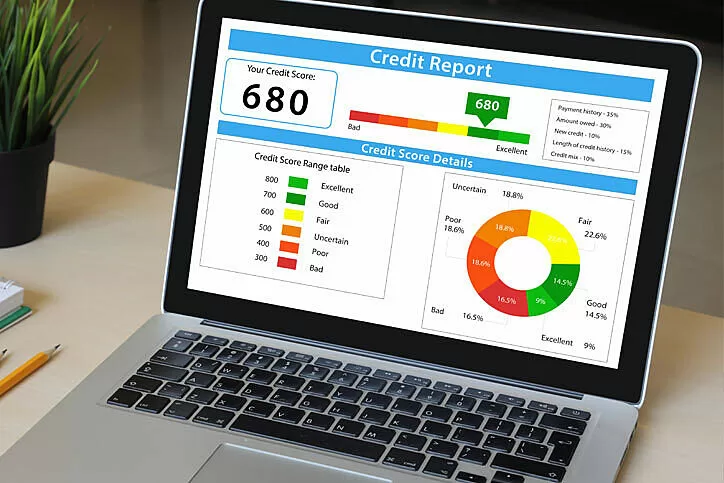
    An opened PC reflecting a credit report showing high credit utilization

    Credit scores are calculated based on five factors: 

    1. Payment history

    2. Credit usage (or utilization)

    3. Length of credit history

    4. New credit inquiries

    5. Types of credit. 

    Among these, credit utilization is one of the most impactful. Lenders look at your revolving utilization as a sign of how well you manage your credit.

    How High Utilization Affects Your Credit Score

    A man surprisingly looking at his poor credit score on the laptop screen due to high credit utilization

    When your revolving utilization is high, it can signal to lenders that you may be over-leveraged or having trouble managing debt. 

    This could lead to lower credit scores, making it harder to get approved for loans, credit cards, or even a mortgage. A utilization rate above 30% is considered high, and anything higher will typically start to hurt your score.

    Why Does High Credit Utilization Decrease Your Credit Score?

    Credit bureaus use your revolving utilization to determine how much of your credit you’re actually using. Here’s how it affects your score:

    • Risk Indicator: If you’re using too much of your available credit, it can be a red flag for lenders that you’re financially stretched and might struggle to pay back your debts.

    • Credit Scoring Models: FICO, one of the most widely used credit scoring models, places a significant weight on credit utilization, about 30% of your overall score. The higher your utilization, the more it drags down your score.

    How to Calculate Revolving Utilization

    The formula for calculating revolving utilization is simple:

    Where:

    • Total Credit Card Balances is the sum of the outstanding balances across all your revolving credit accounts (credit cards, lines of credit, etc.).

    • Total Credit Limit is the total credit limit across all your revolving credit accounts.

    This formula gives you the percentage of your available credit that you’re using. The lower this percentage, the better it is for your credit score. Aim to keep it below 30% for optimal results.

    For instance, if you have a credit card with a $5,000 limit and a balance of $2,000, your utilization rate is 40%. 

    Calculating your credit utilization is straightforward. Take the balance on each of your revolving credit accounts and divide it by your total credit limit. Multiply the result by 100 to get your utilization percentage.

    Example:

    • Balance: $2,000

    • Credit Limit: $10,000

    • Utilization: ($2,000 / $10,000) * 100 = 20%

    Ideally, you’d want your revolving utilization to be under 30%. If you’re above that, it’s time to take action by signing up with Credit Veto.

    What Happens When Your Revolving Utilization Is Too High?
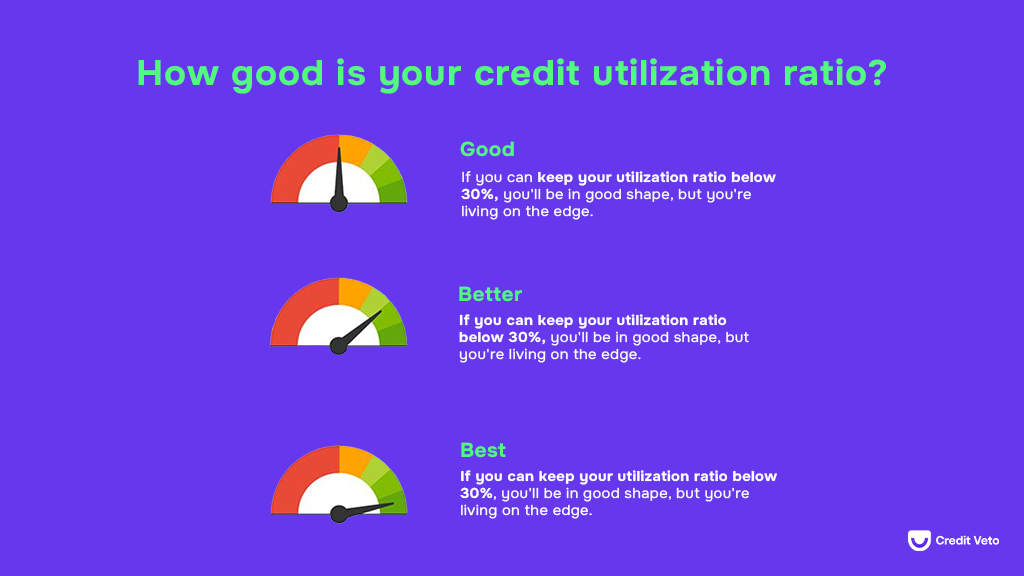
    Infographics showing how credit revolving utilization can be good, better and best

    If your revolving utilization is above 30%, you might start to see some negative effects. Here’s what could happen:

    • Higher Interest Rates: Lenders may offer you loans or credit at higher interest rates due to the perceived risk.

    • Lower Approval Chances: When you have high revolving utilization, you may struggle to get approved for additional credit, especially if you’re already maxing out existing credit lines.

    • Negative Impact on Credit History: Repeatedly carrying high balances can have a long-term impact on your credit score, making it harder to improve.

    How to Lower Your Revolving Utilization

    Reducing your revolving utilization is one of the quickest ways to boost your credit score. Here are a few steps you can take:

    1. Pay Down Your Balances

    The most straightforward way to lower your utilization is by paying off your credit card balances. Try to pay off at least 20-30% of your balance to get under that critical 30% mark.

    2. Ask for a Credit Limit Increase

    If your credit card issuer allows it, requesting a higher credit limit can automatically reduce your utilization rate, as long as you don’t increase your spending.

    3. Consider Transferring Your Balance

    If you’re struggling with multiple high-interest credit cards, consider transferring your balance to one with a lower interest rate or a 0% introductory APR. This can help you pay off debt faster and reduce your utilization.

    4. Avoid Closing Old Accounts

    Closing old credit card accounts can decrease your total available credit, which will increase your utilization rate. Keep older accounts open and avoid closing them, even if you’re not using them.

    Do Personal Loans Affect Credit Utilization?

    Personal loans are installment loans, meaning they aren’t factored into your revolving utilization because they aren’t revolving lines of credit. 

    However, using a personal loan to pay down credit card debt can lower your revolving utilization and, in turn, help improve your credit score. This strategy allows you to consolidate your debt while keeping your credit usage under control.

    Credit Utilization Penalties and How to Avoid Them

    One of the most significant penalties for high credit utilization is the negative impact on your credit score. But there are other penalties too, like:

    • Over-the-limit Fees: Exceeding your credit limit can result in fees that further add to your debt.

    • Increased Interest Rates: High utilization can also lead to higher interest rates on future credit.

    To avoid these penalties, keep your balance low, make payments on time, and monitor your credit regularly.

    Why Credit Repair Matters for Managing Utilization

    If you’re struggling to improve your credit utilization, credit repair services like those offered by CreditVeto can help. We provide expert fixes to help you address negative credit report items, reduce debt, and manage your credit more effectively.

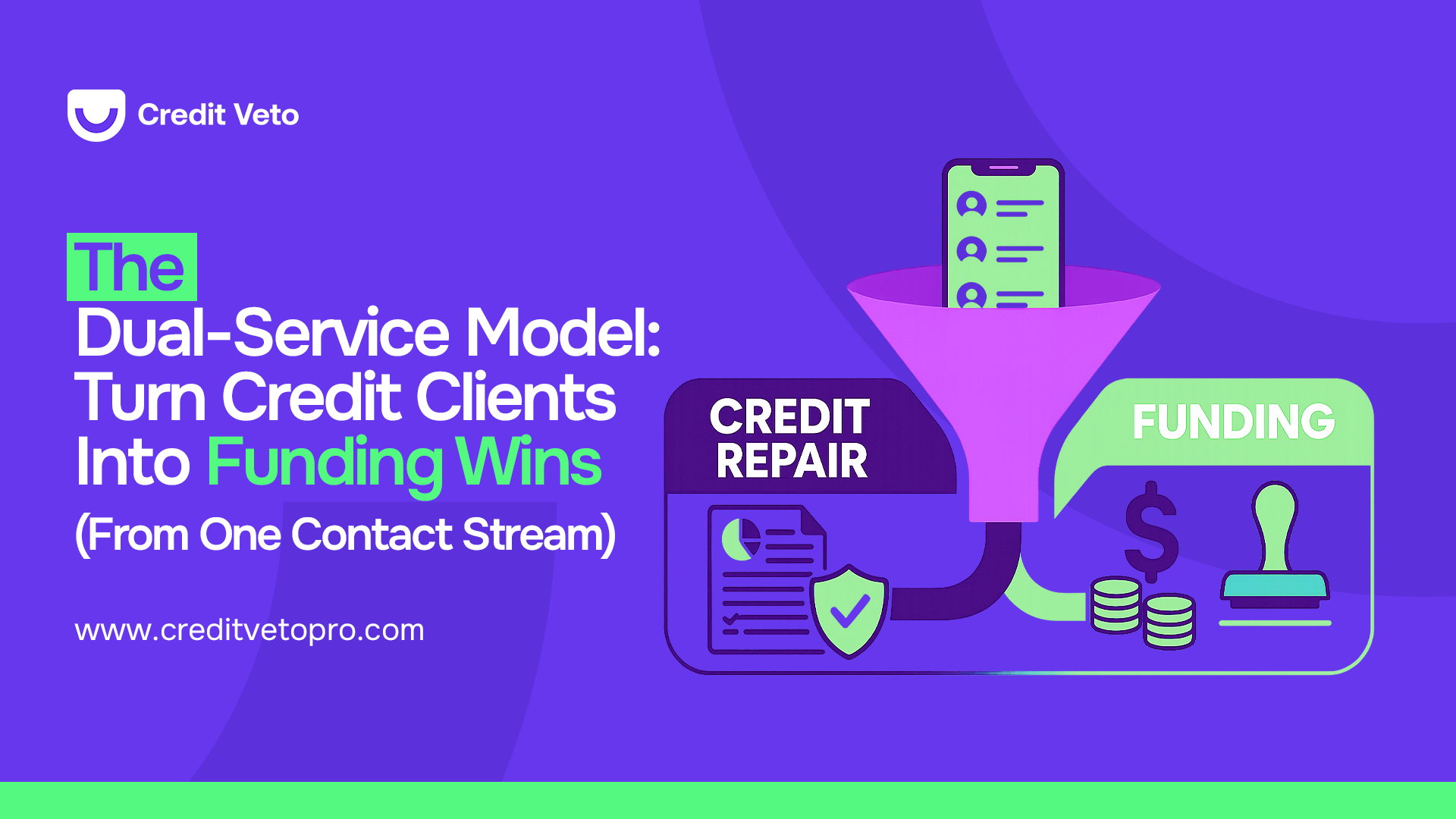
    Our Dual-Service Model allows businesses to help clients not only improve their credit but also access funding. This combination is a powerful way to help your clients repair their credit while simultaneously securing the funding they need to grow. 

    If you’re a credit repair specialist looking to increase your revenue with credit repair services, integrating credit repair and funding services into your offerings can lead to increased client satisfaction and business growth.

    See Also: How to Become a Certified Credit Repair Specialist

    Final Thoughts

    Understanding and managing your revolving utilization is essential for maintaining a healthy credit score. By keeping your utilization low, paying off balances, and using credit wisely, you can boost your score and increase your chances of securing the credit you need. 

    Whether you’re working on your own credit or offering credit repair services, mastering utilization is a crucial step toward financial success. Sign up with credit veto today to get started.

    Frequently Asked Questions (FAQs)

    Is 20% revolving utilization good?

    Yes, a 20% revolving utilization rate is considered good for your credit score. It’s well below the 30% threshold, which is recommended for maintaining a healthy credit score.

    Does 0% utilization hurt credit score?

    No, a 0% utilization rate does not hurt your credit score. In fact, it can be beneficial as it shows that you are not relying heavily on credit. However, it’s important to use credit occasionally to maintain an active credit history.

    What is revolving utilization on Discover?

    Revolving utilization on Discover refers to the percentage of your credit limit that you’re using on Discover credit cards. It is calculated by dividing your balance by your credit limit and multiplying by 100.

    What is an example of a revolving account?

    A revolving account is a type of credit account where you can borrow up to a limit and carry a balance month-to-month. Examples include credit cards, home equity lines of credit (HELOC), and lines of credit from financial institutions.

    How does revolving utilization affect my credit score?

    Revolving utilization affects your credit score by showing how much of your available credit you’re using. High utilization (above 30%) can lower your score, while low utilization helps improve it.

  • Managing Credit Utilization: 5 Smartest Ways to Boost Your Score

    Managing Credit Utilization: 5 Smartest Ways to Boost Your Score

    Managing credit utilization is one of the fastest ways to improve your credit score. While paying bills on time and removing collections help, keeping your credit usage low is often the real game changer most people miss.

    If you’ve ever asked yourself, “Should I reduce my credit card limit?” or “Is it beneficial to use some of your available credit?” you’re not alone. These questions point to one of the most powerful, yet misunderstood, parts of your credit health: your credit utilization ratio.

    In this blog post, we’ll break it all down. Whether you’re at a 565 credit score trying to climb or already have a 680 credit score and want to optimize it, this guide will give you real, practical answers.

    Let’s get into it.

    What Is Credit Utilization Ratio, and Why Does It Matter?

    A man surprisingly looking at his poor credit score on the laptop screen due to high credit utilization

    Your credit utilization ratio refers to how much of your available revolving credit (like credit cards) you’re using at any given time. It’s calculated by dividing your current credit balances by your total available credit.

    So, if you have a $1,000 balance on a $5,000 credit limit, your utilization is 20 percent.

    Credit utilization makes up about 30 percent of your credit score, which means it can either be your biggest ally or your sneakiest enemy.

    Experts often recommend keeping this number below 30 percent, but for better optimization for credit health, aim for under 10 percent.

    Why Managing Credit Utilization Impacts Your Score

    An opened PC reflecting a credit report showing high credit utilization
    An opened laptop displaying a credit report with a score of 680

    Your credit score is essentially a snapshot of how responsibly you manage debt. One of the biggest signals credit bureaus use is how much of your available credit you’re using; this is called your credit utilization ratio. And here’s the thing: managing credit utilization is just as important as paying your bills on time.

    Even if you’ve never missed a payment, high credit utilization can still drag your score down. Why? Because it signals that you might be relying too much on credit to get by, and that makes lenders nervous.

    Think of it like this:

    • Low utilization = You’re in control. It shows that you’re using credit as a tool, not a crutch.
    • High utilization = You might be risky. Even if you’re paying things off, maxed-out cards suggest your finances are stretched.

    And here’s where most people get tripped up: Your credit card balance is reported to the bureaus once a month, usually right around your statement closing date. So even if you pay your card in full after that date, the high balance can still show up on your report and hurt your score.

    That’s why managing credit utilization proactively is so important. It’s not just about paying off debt; it’s about when and how much you use at any given time. Keeping your usage low before the reporting date can make a noticeable difference in your score, even if nothing else changes.

    Read Also: 7 Ways to Fix an Unscorable Credit

    5 Smartest Ways to Boost Your Score and Improve Your Utilization Ratio

    Now that you understand why managing credit utilization matters, let’s look at what you can actually do about it. These are five of the smartest ways to boost your credit score by improving how you use your available credit, and they work even if your income isn’t high or your debt feels overwhelming.

    1. Spread Out Your Charges Across Multiple Cards

    If you use just one card for everything, that card’s utilization ratio can climb fast. Even if your total utilization is low, the high balance on a single card can still impact your score.

    Try this:

    Distribute your spending across two or three cards. Keep each card’s balance under 30 percent of its individual limit.

    This way, your total utilization stays healthy, and none of your cards are flagged as “maxed out.”

    2. Ask for a Credit Limit Increase (Without Increasing Spending)

    If you’re wondering whether to reduce your credit limit, here’s the truth: It may actually be smarter to increase your credit limit, not decrease it. Why?

    Because increasing your limit lowers your utilization, as long as your spending stays the same.

    Let’s say your current limit is $2,000 and you carry a $1,000 balance. That’s 50 percent utilization.

    But if your limit increases to $4,000 and your balance stays at $1,000, your utilization drops to 25 percent. That’s a big score improvement without paying off anything extra.

    Pro-Tip: Call your issuer or request a limit increase online. Just avoid doing this right before a major loan application; it could trigger a hard inquiry.

    3. Make Early Payments Before the Statement Closes

    Your balance is reported to credit bureaus around your statement closing date; not your due date. So if you always wait until your due date to pay, you might be reporting high balances even though you’re not carrying debt.

    Solution:

    Make a mid-cycle payment before the statement closes. That way, a lower balance gets reported, and your utilization looks better.

    This is especially important if you’re using your card heavily for everyday expenses.

    4. Don’t Close Old Cards Unless You Have To

    A man worriedly looking at coputer screen with a credit  card in his hand

    “Should I reduce my credit card limit?”

    It depends. If your card has a high annual fee and no real benefits, it might make sense. But if the card is fee-free, consider keeping it open.

    Closing a credit card reduces your total available credit, which instantly increases your utilization ratio. That’s risky if you still carry balances on other cards.

    Example:

    Let’s say you have three cards with limits of $3,000 each (total of $9,000) and you carry a $1,500 balance.

    Your utilization: 16 percent.

    Now you close one card. Your limit drops to $6,000, and your utilization jumps to 25 percent, without spending a dime.

    Better option? Hide the card, freeze it, or ask for a product change to a no-fee version instead.

    5. Monitor and Optimize with Tools Like Credit Compass

    If you want to stay on top of your score and utilization trends, consider using a credit tracking tool. Credit Compass and other services like Credit Veto offer dashboards where you can see your score, utilization by card, and get smart tips.

    Benefits of using a tool:

    • See when your balances are getting too high
    • Track real-time changes to your score
    • Get optimization tips to improve credit health faster

    At Credit Veto, we believe in helping you simplify all this with a plan you can install and follow, even if you’ve never checked your score before.

    Extra Tip: Is It Beneficial to Use Some of Your Available Credit?

    Yes, but in moderation.

    Lenders like to see that you’re using credit responsibly. So using some of your available credit and paying it off regularly shows healthy activity.

    But if you’re maxing out your cards, even temporarily, it could send the wrong signal.

    Stay active, but stay low. That’s the rule.

    Final Thoughts: Master the Ratio, Master Your Score

    Whether you’re working to improve a 675 credit score or aiming to push your 680 score past 700, managing credit utilization is one of the easiest ways to make progress fast.

    It doesn’t require you to spend more or even pay off huge amounts. It’s all about strategy.

    Here’s what to remember:

    • Use less of what’s available to you
    • Don’t reduce your limits unless you must
    • Spread spending across cards
    • Pay before statements close
    • Track and optimize with tools

    Small shifts here can move the needle in a big way.

    And if you’re feeling stuck? Credit Veto is built to make all this easier. With tools, templates, and real help, we don’t just tell you what to fix; we help you install a smarter system.

    Remember, good credit isn’t about working harder, It’s about working smarter. Sign up with Credit Veto Pro to not just fix your credit but help hundreds of people do the same and earn from it.

  • New Dual-Service Model: Turn Credit Clients Into Funding Wins (From One Contact Stream)

    New Dual-Service Model: Turn Credit Clients Into Funding Wins (From One Contact Stream)

    Offering business funding for credit repair clients (inside one workflow and one platform) lets you solve the full problem (credit and capital) for the same person. This dual-service model lifts revenue per client, shortens time-to-value, and keeps you compliance-first while you scale.

    If you already run or are launching a credit business and want to scale fast, single-service delivery caps your growth. 

    Clients don’t just need credit repair; many also need capital to buy a home, expand a business, or consolidate debt. Running both services from one contact stream is how modern operators graduate from busy to scalable.

    What is the “dual-service model”?

    A credit repair specialist smiling and using the dual-service model to convert his client.

    A delivery model where one operator runs credit repair and business funding from one contact stream; a single intake, unified credit repair CRM, shared client portal, and one auditable paper trail from start to finish.

    Why it works (and what’s inside):

    • Problems travel together. Many clients who need credit help also need capital to buy a home, grow a business, or consolidate debt—so business funding for credit repair clients is a natural second step.
    • One intake, zero drop-offs. Collect identity, reports, and docs once. The same record powers disputes (for inaccuracies) and, when eligible, a funding application, no duplicate forms, no lost momentum.
    • Eligibility gates, not guesses. After disputes and behavior fixes, the system checks milestones (e.g., lower utilization, clean recent history) and flags when the client is funding-ready.
    • Tighter client experience. The client sees both tracks (credit and funding) in one portal with status, tasks, and messages. Fewer “any updates?” calls, higher trust.
    • Full control = better outcomes. You shape the journey end-to-end: fix credit so clients can qualify for funding, then package capital responsibly.
    • Compliance by design. One trail of contracts, disclosures, dispute letters, evidence, and lender docs makes CROA alignment easier to prove.
    • Operational lift. Fewer handoffs, fewer errors, faster SLA times, and higher revenue per client, because you’re solving the whole problem with a dual-service model, not half of it.

    Read Also: How to scale credit repair business the right way

    Credit + Funding from One Contact Stream (how it flows

    A credit repair business specialist shaking his client in his ofice, both smiling.

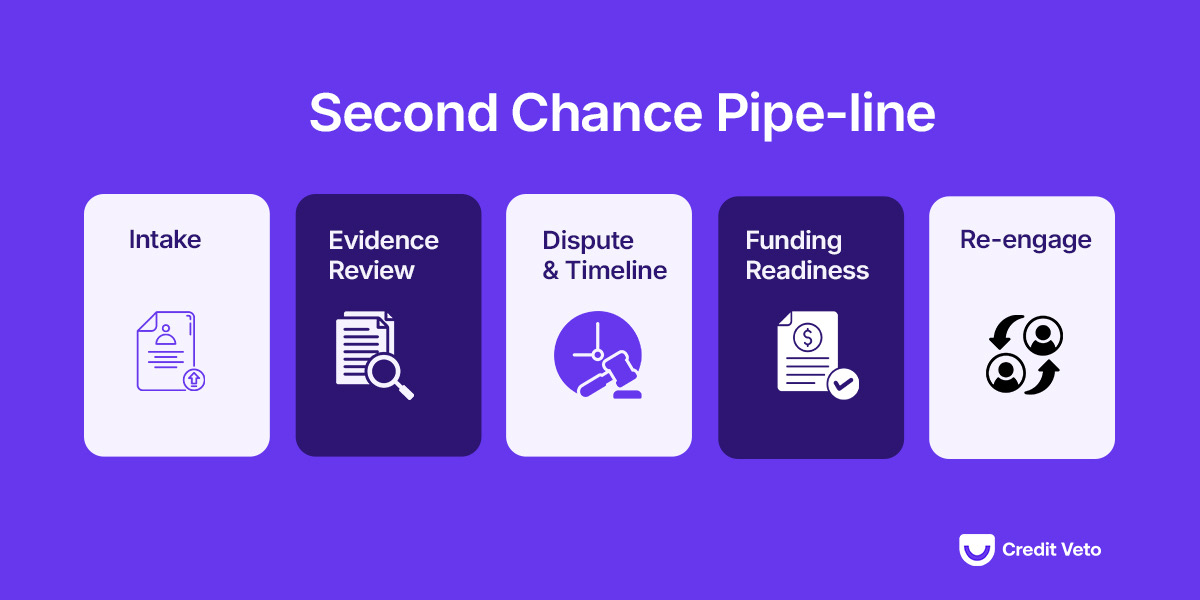
    Here’s the dual-service model in practice: one pipeline in your credit repair CRM that runs both credit repair and business funding. The goal is simple: reduce hand-offs, keep a single paper trail, and move qualified clients from credit work to capital efficiently.

    1. Intake & triage
      • Pull reports, verify identity, capture consent, and gather core docs (ID, proof of address, income).
      • Classify each record: Credit-only, Funding-only, or Credit + Funding; tag the path in your CRM.
    2. Credit plan (if needed)
      • Correct inaccuracies only (FCRA-aligned disputes with documentation and timestamps).
      • Stabilize the behaviors that move scores (utilization targets and on-time streaks) and set SLA timers.
      • Track bureau responses and round dates inside the pipeline.
    3. Funding plan
      • Collect a clean document checklist (bank statements, basic financials, entity docs).
      • Route by profile: term loans, lines of credit, equipment, revenue-based, or responsible starter credit when appropriate.
      • Track conditions and decisions; surface status changes in the client portal.
    4. One portal, one timeline
      • Clients see both tracks (credit and funding) with clear next steps and due dates.
      • Automated reminders keep e-signs and uploads moving; fewer “any updates?” messages.
      • All messages, files, and actions live in the same record for an auditable trail.
    5. Closed-loop analytics
      • Watch revenue per client, dispute throughput, approval rate, time-to-funding, and SLA adherence in dashboards.
      • Spot where clients stall, fix that step once, and improve throughput for every future case.

    Compliance note: Dispute only inaccuracies. Don’t promise to remove accurate, verifiable information or guarantee funding; present business funding for credit repair clients as eligibility-based.

    See Also: The New Upsell System Helping Struggling Businesses Bounce Back Stronger

    Man looking at his PC to see why the dual-service model wins now

    Why this model wins now

    • Client reality: People want both approval and affordability. Fixing credit without funding leaves money (and outcomes) on the table.
    • Operator efficiency: One intake, one identity verification, one portal; fewer handoffs.
    • Compliance clarity: One audit trail across services, easier to demonstrate good faith, and CROA/FCRA-aligned processes.
    • Revenue per client: Ethically increase lifetime value by solving the full financial problem.

    The Essentials You Need

    To run the dual-service model properly, “best software” means operating system, not just a letter tool:

    • Credit repair CRM (contacts, pipelines, tasks, roles/permissions).
    • Dispute automation (custom letters, evidence attachments, SLA timers, e-notary/certified mail options).
    • Client portal (status, documents, messaging).
    • Compliance guardrails (CROA/FCRA disclosures, contracts, cancellation windows, audit trails).
    • Payments (one-time + subscriptions, receipts, and dunning).
    • Funding workflows (intake → lender routing → status → payouts).
    • Analytics (CAC/LTV, pipeline velocity, dispute throughput, approval rate, SLA adherence).

    At Credit Veto Pro, we call this ScaleTech CRM, that is CRM at the core, with delivery and growth rails around it, so you can run credit repair and business funding from one contact stream.

    14-Day Launch Plan (dual-service model, end-to-end)

    Days 1–3: Configure the OS

    • Import contacts (phone, CRM exports, declined apps).
    • Turn on roles/permissions, brand the portal, and connect payments.
    • Load CROA/FCRA-aligned contracts and disclosures.

    Days 4–6: Map both pipelines

    • Credit pipeline: Intake → analysis → dispute plan → send → reinvestigate.
    • Funding pipeline: Intake → docs checklist → lender routing → underwriting → funding.

    Days 7–9: Templates & automations

    • Email/SMS for document requests, status updates, and next steps.
    • SLA timers for disputes; reminders for funding docs and signatures.
    • Calendar + call logging + notes standardized for the team.

    Days 10–12: Reactivation sprint

    • Rank your contacts by “credit-only,” “funding-only,” or “dual opportunity.”
    • Use short scripts to book audit calls; move qualified prospects into the right tracks.

    Days 13–14: QA & go-live

    • Send a small batch through both pipelines; fix bottlenecks.
    • Verify receipts, trails, and portal visibility for compliance housekeeping.

    Scripts that book calls (use and personalize)

    Text (warm contact):

    “Hey {{First}}, quick update; my team now helps with credit repair and business funding in one plan. Want me to check what you could qualify for?”

    Email (2-line opener):

    “Reviewing past clients for credit and funding options. If you’d like a quick credit-and-capital check, reply YES and I’ll run it.”

    Call opener:

    “We solve both hurdles—the credit piece and the funding piece—in one plan, so you don’t bounce between companies. Can I walk you through how it works?”

    (Always keep claims accurate; don’t promise removals of truthful negatives or guaranteed approvals.)

    Pricing & packaging (framework, not numbers)

    • Credit-only plan (30/60/90-day options).
    • Funding-only plan (by product type).
    • Dual plan (bundled), clear scope and timeline.
    • Add monitoring and document prep as value-adds; keep language compliant and transparent.

    KPIs that tell you it’s working

    • Lead → audit call rate (from ranked outreach).
    • Audit → paid conversion.
    • Dispute throughput (letters/client, on-time %).
    • Funding approvals & time-to-funding.
    • Revenue per client and refund rate.
    • SLA adherence (no missed dispute deadlines, clear comms).

    If you can’t see these in a dashboard, you’re guessing.

    The bottom line (and your next step)

    If you’re still running single-service, you’re solving half the client’s problem and leaving revenue behind. The dual-service model, credit repair + business funding from one contact stream—lets you deliver outcomes end-to-end, increase revenue per client, and scale with compliance at the core.

    See how operators run this in one login.

    Watch the 15-minute strategy or book a quick call to tour the dual-service workflows, client portal, and dashboards inside Credit Veto Pro.

    Frequently Asked Questions (FAQs)

    Q: What is “business funding for credit repair clients”?

    It’s the practice of packaging capital solutions (lines, term loans, revenue-based, equipment, or responsible starter credit) alongside credit repair, so qualified clients get funding once their profile supports it.

    Q: Is this compliant?

    Yes, when delivered with CROA/FCRA-aligned contracts, accurate disclosures, a clear scope (no guarantees), and a defensible paper trail. Your platform should guide these steps.

    Q: Can I start with credit only and add funding later?

    Absolutely. Many operators start with credit, then add funding workflows once delivery is stable and documents are routine.

    Q: Do I need a large team?

    No. With automation and a client portal, solo operators can run both tracks. Add processors as throughput grows.

  • Is a 609 Credit Score Bad or Just Misunderstood?

    Is a 609 Credit Score Bad or Just Misunderstood?

    Short Answer: A 609 credit score isn’t great, but it’s not necessarily bad either. It falls into the fair range, meaning there’s room for improvement, but it’s not a dealbreaker when it comes to things like loans or credit cards.

    If you’ve ever pulled your credit report and seen a 609 credit score staring back at you, you’re not alone. It’s the kind of score that sits in that uncomfortable middle ground. 

    Not quite bad, but definitely not great either. So the big question is: Is a credit score of 609 good, or are you in trouble? Let’s break this down honestly and give you the clarity most articles don’t.

    What Does a 609 Credit Score Really Mean?

    A credit score chart by FICO showing where a 609 credit score falls under a category

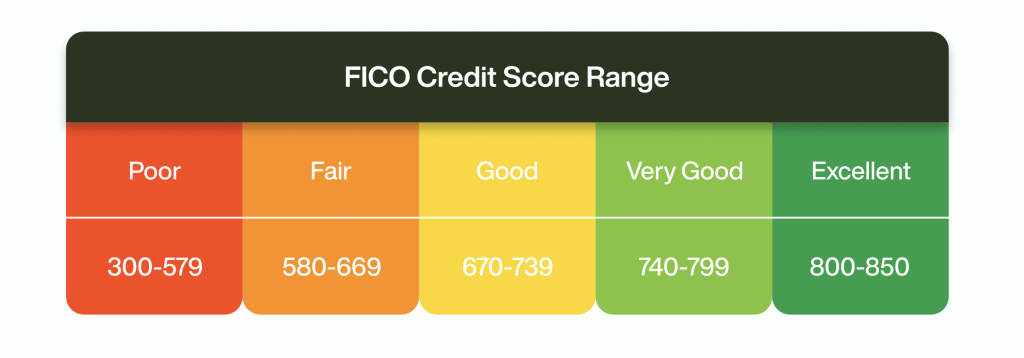
    A 609 credit score sits in the “fair” range on the FICO scale, which spans from 300 to 850. It’s not considered a bad score outright, but it definitely signals to queen lenders that you may have had some financial hiccups like missed payments, high utilization, or possibly collections. 

    If you’re asking, “Is a credit score of 609 good?” The answer depends on your goals. For premium credit cards or low-interest mortgage rates, it’s not ideal. But it’s not the worst either.

    Most lenders see a 609 credit score as a financial yellow light,not a full stop, but not a green light either. You’re still able to qualify for credit products, but usually under less favorable terms. This includes higher interest rates, lower approval limits, and sometimes additional requirements like a cosigner or security deposit.

    So, is a 609 credit score bad? Not exactly. It’s more of a warning that your credit profile needs improvement (and fast)if you want to access better financial opportunities. This is where many blogs stop short, but here’s what most don’t tell you:

    • A 609 score often contains outdated or fixable negative items such as collections, old inquiries, or incorrect account details. These can be disputed and possibly removed.
    • Many consumers stay stuck at 609 simply because they don’t know which credit behaviors matter most. Knowing how to prioritize your actions, like focusing on utilization and removing errors, can push you above 640 in a few weeks.

    Bottom line? A 609 credit score is not your final destination. With the right strategies and tools, you can rebuild your credit and escape the high-interest trap that most “fair credit” borrowers fall into.

    Read Also: 6 Best Ways to Remove Paid Collections from Your Credit Report

    Is a 609 Credit Score Bad? Or Just Misunderstood?

    A curious lady with a credit card in one hand and phone in the other wondering what a 609 credit score is good or bad

    This is where most articles miss the mark. Some sugarcoat it. Others lean heavily on fear. But the truth is this; a 609 credit score is not excellent, yet it’s far from hopeless. What people really need to hear is that it’s not just about the number. It’s about why the number exists.

    So, is 609 credit score bad? Technically, it falls into the fair category, which means it’s below average but not dangerous. You might not get premium credit cards or the best loan rates, but you’re not locked out of financial opportunities either.

    In reality, many people land at a 609 credit score because of things like:

    • Old or unpaid medical bills
    • High balances on revolving credit cards
    • One or two late payments
    • No credit history at all, especially for immigrants, young adults, or people who avoided debt entirely

    Most of these issues aren’t rooted in recklessness. They stem from a lack of credit education, missed notices, or financial emergencies. That’s why calling a 609 credit score “bad” is misleading. What you actually need is the right roadmap, not more shame or confusion.

    And this is where you have an edge. If you take action early, a 609 credit score can be turned around in less time than you think. Unlike the articles that simply label it fair or poor, we’re showing you how to move forward with clarity and strategy.

    Why Your Credit Score Matters More in 2025 Than Ever

    a handing checking their credit score on the phone

    In 2025, a 609 credit score matters more than it ever did. Lenders are no longer just looking at your score, they’re analyzing your entire credit behavior with AI-driven tools and deeper data models. So even if your credit score lands in the “fair” range, you’re being evaluated far beyond just the number.

    Is a credit score of 609 good enough today? Not quite. It’s still considered fair, but in today’s stricter lending environment, that often means higher costs and fewer options.

    Here’s what a 609 credit score could mean for you right now:

    • You might miss out on competitive mortgage interest rates, which could cost you tens of thousands over the life of a loan
    • Auto loan lenders may approve you, but with significantly higher interest rates
    • You may be required to pay upfront deposits when renting an apartment or setting up utilities

    And here’s the part many people overlook: AI-powered underwriting tools now weigh patterns, not just points. This means that having a 609 credit score (even if it’s stable) can still be flagged if lenders see high utilization, late payments, or inconsistent activity.

    So if you’re asking is 609 credit score bad, the answer depends on what you plan to do with your credit. But one thing is clear: fixing and improving that score is more urgent now than ever.

    See Also: Default Credit Score: The Surprising Truth & Alternative Scores

    609 Credit Score: What You Can Still Do

    If you have a 609 credit score, don’t assume your options are gone. While it’s not the strongest score, it’s still workable. What matters is knowing where to start.

    So, is a credit score of 609 good? Not exactly. But it’s not the end either.

    Here are smart ways to start rebuilding and still access credit:

    • Secured credit cards: These require a refundable deposit and help build positive credit history
    • Unsecured cards with low limits: Some lenders will approve you for a card with a higher interest rate or smaller credit line
    • Credit builder loans: These are designed to improve your score through structured, manageable payments
    • Rent and utility reporting: Use tools that add rent, phone, or utility payments to your credit file to boost your history

    These steps are often overlooked in generic advice, but they are proven to work. Having a 609 credit score doesn’t make you irresponsible. It usually means you’ve had a setback or lacked guidance. The good news is, you can move up the right approach.

    The Fastest Way to Improve a 609 Credit Score

    If you have a 609 credit score, you’re not alone. Many people are in this range and often ask, “Is a 609 credit score bad?” The truth is, it’s not ideal, but it’s fixable. The key is knowing exactly where to start.

    Here are five proven steps to improve your score fast.

    1. Check Your Credit Report for Errors

    Start by reviewing your reports from Experian, Equifax, and TransUnion. One in five reports contains errors that could be dragging your score down. These mistakes might include outdated accounts, incorrect balances, or wrongly reported late payments.

    Disputing and correcting even a single error could give your score a boost of 30 points or more.

    2. Lower Your Credit Card Utilization

    Your utilization rate is how much of your credit you’re using. For example, if your card limit is $1,000 and your balance is $800, your utilization is 80 percent, which hurts your score.

    Keep it below 30 percent, and ideally under 10 percent, to see real improvements.

    3. Add New Positive Accounts

    To balance out past negatives, add new positives. Use tools that report rent, utility payments, or streaming service subscriptions to credit bureaus. You can also apply for a credit builder loan or secured credit card to build a better history.

    4. Request a Credit Limit Increase

    Call your credit card provider and ask for a limit increase. If approved, your credit utilization improves without you needing to open a new account. Just make sure not to increase your spending along with the new limit.

    5. Dispute Unverifiable or Outdated Items Legally

    If you have old collections or questionable accounts, you may be able to dispute them under the Fair Credit Reporting Act (FCRA).

    Use personalized letters, not generic templates, and challenge items that cannot be verified or are beyond the legal reporting limit. This approach works best when done carefully and within legal guidelines.

    The Problem With Most Advice Online

    We analyzed the top-ranking blogs for the keyword 609 credit score as well as social media posts. And while they explain the basics, they often fall short where it really counts.

    Most of these articles:

    • Gloss over practical next steps you can take right now
    • Avoid talking about real-life credit challenges, like living on a low income or having no credit history at all
    • Skip over legal loopholes you’re actually allowed to use to fix your credit

    One key strategy that rarely gets a proper breakdown is the 609 dispute letter method. It’s based on Section 609 of the Fair Credit Reporting Act, which gives you the right to request full details about items on your report.

    Here’s the truth: the 609 letter isn’t a magical fix, but when written correctly and used strategically, it can trigger investigations that lead to outdated or unverified accounts being removed.

    The secret is personalization. Don’t use copy-and-paste templates from the internet. Write your letters in your own words. Include specific details. And always follow up with the credit bureaus.

    So… Is a Credit Score of 609 Good?

    In simple terms: no, a 609 credit score is not considered good but it’s also not bad enough to stop your progress.

    Think of it as a warning light, not a closed door. It means there’s work to do, but the path forward is still wide open. With the right credit habits, many people can:

    • Move from 609 to 650+ within a month or two
    • Reach 700 or higher in three to six months
    • Start qualifying for lower interest rates, better credit cards, and stronger loan options

    If you’ve been asking if a credit score of 609 bad or good bad, the real answer lies in what you do next. The number doesn’t define you; your next steps do.

    Don’t just scroll through advice. Pick one action today. Then follow it with another tomorrow. That’s how credit improvement happens.

    Final Thoughts

    Whether you searched for things like “ is 609 credit score bad” or just finished checking your report, remember this; your 609 credit score isn’t the end. It’s a snapshot, not a life sentence.

    That number might feel like a wall right now, but it’s really a window. A window into better habits, smarter credit decisions, and real opportunities waiting to be unlocked.

    At Credit Veto, we don’t just teach you what to do; we give you the templates, tools, and guided systems to actually do it. From disputing errors legally to building positive credit history, we help everyday people go from 609 to 720 and beyond, without guessing or falling into common traps.

    If you’re serious about turning that score around, and also discover how you can help people do same and earn from it, Start with Credit Veto Pro. Your future self will thank you.

    FAQs (People Also Ask)

    How long does it take to improve a 609 credit score ?

    With Credit Veto’s tailored strategies, you can start seeing improvements in your score within a few months. Our proven methods for credit repair can help remove inaccuracies and strengthen your credit profile, potentially raising your score above 609.

    What steps can I take to improve my 609 credit score using Credit Veto?

    Credit Veto helps you identify the specific issues holding your score back. Whether it’s late payments, high balances, or inaccurate information, we provide you with the tools and guidance to address them. Our step-by-step process can help raise your score and improve your financial outlook.

    What steps can I take to improve my 609 credit score using Credit Veto?

    Credit Veto helps you identify the specific issues holding your score back. Whether it’s late payments, high balances, or inaccurate information, we provide you with the tools and guidance to address them. Our step-by-step process can help raise your score and improve your financial outlook.

  • Hard Inquiry vs Soft Inquiry: The Real Difference That Can Save or Sink Your Credit Score Fast

    Hard Inquiry vs Soft Inquiry: The Real Difference That Can Save or Sink Your Credit Score Fast

    Short Answer: A hard inquiry happens when a lender checks your credit for a loan or credit card. It can lower your score slightly for a short time. A soft inquiry happens when you or a company checks your credit for background reasons, and it never affects your score.

    Most people in the U.S. believe that every time someone checks their credit, their default credit score drops. That’s not true.

    The truth is that credit checks come in two types (hard and soft), and they affect your score very differently.

    Many Americans lose points on their credit report because they don’t understand how these checks work. Others avoid checking their credit altogether because they fear a score drop. 

    But once you understand how hard inquiry vs soft inquiry really works, you’ll stop fearing your credit report and start using it as a tool to build wealth.

    Let’s break it down in simple terms.

    What Is a Credit Inquiry?

    A curious lady with a credit card in one hand and phone in the other wondering what a credit inquiry is and the difference between hard inquiry and soft inquiry

    A credit inquiry is a request to look at your credit report. Your credit report is like a personal history file that shows how you’ve handled loans, cards, and payments.

    It helps lenders decide if they can trust you with money. Every time a lender, employer, or even you checks your credit, that action is logged as an inquiry.

    But here’s what most people miss: not all inquiries are treated equally. Some inquiries tell lenders, “This person is shopping for money,” while others simply say, “This person is checking information.”

    That is the difference between a soft and a hard credit check.

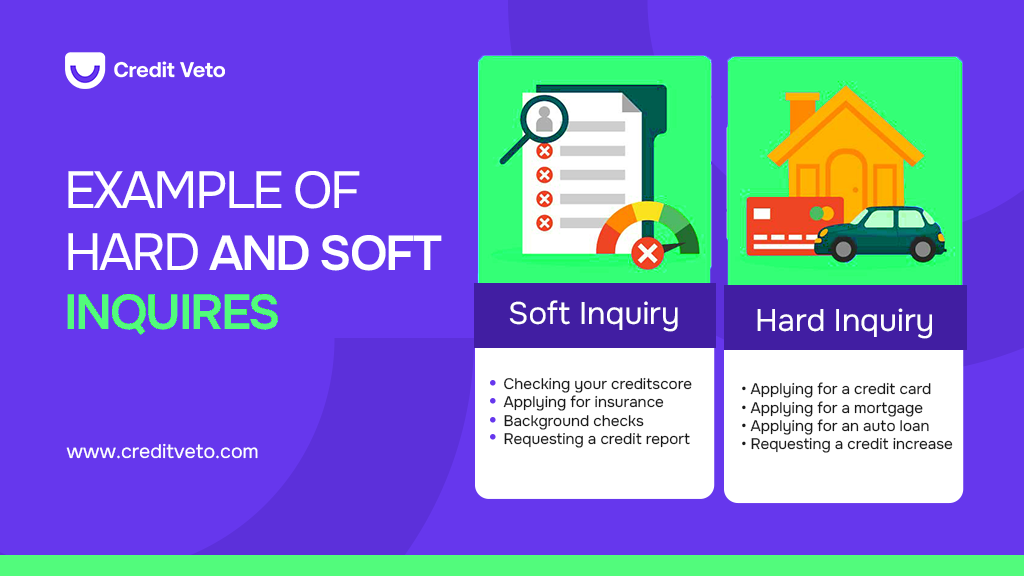
    Examples of Hard vs Soft Inquiry

    Image illustrating examples of hard  inquiry and soft inquiry.

    Now, let’s understand what a hard and soft credit inquiry is with some examples.

    What Is a Hard Inquiry?

    A hard inquiry happens when you apply for something that involves borrowing money. This could be a credit card, a mortgage, a car loan, or a personal loan.

    A lender checks your credit report to decide whether to approve you. Because they are making a financial decision, the credit bureau records it as a hard pull.

    Each hard inquiry can lower your credit score by around two to five points.

    It’s not much, but if you apply for many loans or cards in a short period, the drops can add up. A hard inquiry stays on your credit report for two years, but it only affects your score for about twelve months.

    Example:

    • If you apply for a car loan today, the bank runs a hard inquiry.
    • If you apply for three credit cards next week, that’s three more hard inquiries.

    The scoring model might see that as risky behavior, like someone short on cash. But if you space out your applications, the impact is small and temporary.

    Hard inquiries aren’t bad. They’re just signs that you’re using credit. The key is to manage how often they happen.

    What Is a Soft Inquiry?

    A soft inquiry is a credit check that does not affect your score. It happens when you check your own credit or when a company does a background or pre-approval check that doesn’t involve a lending decision.

    Examples of soft inquiries include:

    • Checking your score through credit repair apps and AI-powered systems like that as Credit Veto.
    • Getting pre-approved for a loan or card.
    • A potential employer is checking your report as part of a background review.
    • Insurance companies running risk checks before offering coverage.

    Soft inquiries show up on your personal credit report, but only you can see them. Lenders cannot. That means you can check your score every day if you want to, and your credit will stay the same.

    Hard vs Soft Credit Pull: The Real Difference

    The biggest difference between a hard and soft credit pull is how they affect your score.

    A hard credit pull tells scoring systems that you’re seeking new credit.

    A soft pull is just for information, not money.

    Here’s a quick way to remember it:

    TypeWho Requests ItPurposeVisible to LendersAffects Score
    Hard InquiryLenderCredit applicationYesYes
    Soft InquiryYou or the companyBackground check or pre-approvalNoNo

    If you’re checking your own score, it’s always a soft credit pull.

    If a bank is checking your score to approve a loan, it’s a hard pull.

    It’s that simple.

    Why Many People Get This Wrong

    A lot of people avoid checking their credit out of fear. They think that every look at their report will damage their score. That’s why misinformation spreads. But ignoring your credit is actually worse. You can’t fix what you don’t see.

    Checking your credit score regularly is one of the best ways to stay alert for fraud or errors. Soft checks are your friend. They help you see where you stand without hurting your score.

    The real problem is not checking your credit; it’s applying for too many loans too quickly.

    The Hidden Impact on Lenders and Borrowers

    Lenders use both types of inquiries differently. When they run a hard inquiry, they’re judging your risk. When they run a soft one, they’re screening you as a potential customer.

    For example, when you get those “You’re pre-approved!” credit card offers in the mail, that’s based on a soft pull. The company reviewed your report lightly to see if you fit their requirements.

    When you respond to that offer and apply, it turns into a hard inquiry. So one inquiry can actually turn from soft to hard depending on your next action.

    The Shopping Window Secret

    Here’s something the credit bureaus don’t always make clear. If you apply for several car loans or mortgages within a short period, the system treats those multiple inquiries as one.

    Why?

    Because it assumes you’re shopping for the best rate, not desperate for credit. This window is usually 14 to 45 days long, depending on the scoring model.

    So if you’re comparing mortgage rates from three banks in two weeks, that counts as one hard inquiry.

    Smart borrowers use this rule to their advantage. It lets you shop around without damaging your score.

    How to Handle Hard Inquiries Without Hurting Your Score

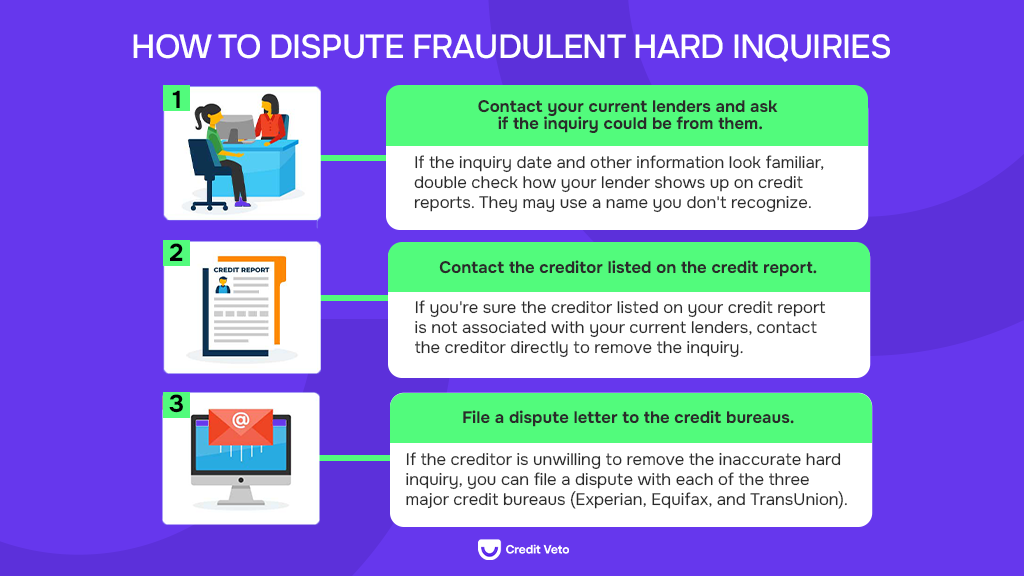
    Infographics showing how to dispute fraudulent hard inquiries

    Here are the top 5 key strategies you can use to handle a hard inquiry affecting your credit score.

    1. Plan before applying.

      Only apply for credit when you truly need it. Don’t fill out every pre-approval you see.
    2. Space out your applications.

      Give at least three to six months between major applications.
    3. Monitor your credit reports often.

      Check for unauthorized inquiries. You can get free reports from annualcreditreport.com or use systems like Credit Veto.
    4. Dispute any inquiry you didn’t approve.

      Unauthorized hard inquiries can be removed by contacting the credit bureau or working with a credit repair company like Credit Veto.
    5. Build a strong payment history.

      A few hard inquiries won’t hurt if you consistently pay on time and keep low balances.

    Remember, lenders look at your full profile, not just one score drop.

    Why This Knowledge Matters

    A single misunderstanding about credit checks can cost you real money. People with strong scores get better loan rates, lower interest rates, and higher limits.

    People with weak scores pay more for the same things: cars, apartments, phones, and insurance. The difference between a soft and hard credit check could mean saving hundreds or losing them.

    For instance, someone with a 760 score might get a 5% rate on a car loan, while someone at a 680 score pays 8%. That small gap costs thousands over the life of the loan.

    Understanding how inquiries work helps you stay in control of your credit journey.

    Common Myths About Hard and Soft Inquiries

    1. Every credit check lowers my score.

    False. Only hard inquiries can lower your score.

    1. I shouldn’t check my score often.

    False. Checking your score through a soft pull keeps you informed and safe.

    1. Hard inquiries ruin your credit.

    False. The impact is small and temporary unless you apply for many accounts at once.

    1. You can’t remove hard inquiries.

    False. If a company checked your credit without consent, it can be disputed and removed.

    1. Soft inquiries don’t matter.

    False. While they don’t affect your score, they help you catch identity theft and monitor your credit growth.

    The Emotional Side of Bad Credit

    Building credit can be stressful. Many people feel judged by a number they don’t fully understand. But your credit score isn’t a report card on your worth.

    It’s simply a measure of financial behavior that can change over time. Every good payment, every low balance, and every responsible move adds up.

    Knowing how hard inquiry vs soft inquiry works gives you control again. You’re not at the mercy of lenders. You can plan, build your credit, grow smarter, and even start helping others do the same and earn from it.

    Read Also: How to Become a Certified Credit Repair Specialist in 2025 (Even If You’re Starting from Scratch)

    Conclusion

    The difference between a soft and hard credit check is small in definition but huge in impact. Soft inquiries are safe and help you stay informed.

    Hard inquiries matter only when they pile up. If you’ve been rejected for credit or notice too many hard inquiries on your report, don’t panic.

    At Credit Veto, we help U.S. residents remove unauthorized inquiries, fix reporting errors, and build healthy credit that lenders respect. Sign up with us today to be among the elite with exceptionally good credit.

    Your credit report should be your advantage, not your barrier. Start cleaning up your report with us and start building the score you deserve.

    Frequently Asked Questions (FAQs)

    Do soft inquiries show up on my credit report?

    Yes, but only you can see them. Lenders cannot.

    How long do hard inquiries stay on my report?

    They remain for two years but affect your score for only about twelve months.

    How many points can a hard inquiry lower my score?

    Usually between two and five points, depending on your current credit standing.

    Can I remove a hard inquiry from my report?

    Yes, if it was unauthorized. Contact the credit bureaus or reach out to Credit Veto for help.

    Are soft credit checks safe?

    Yes. They never harm your score and help you monitor your report safely.

    Is it okay to have multiple hard inquiries?

    Yes, if they are spread out or related to rate shopping for one type of loan.

    What is the fastest way to recover from multiple hard inquiries?

    Keep your balances low, pay bills on time, and avoid applying for new credit for a few months.

    What is the difference between hard inquiry and soft inquiry?

    A hard inquiry happens when you apply for credit and can lower your score slightly. A soft inquiry happens for background checks and does not affect your score.

    What is an example of a hard inquiry?

    Applying for a car loan, mortgage, or credit card.

    What is an example of a soft inquiry?

    Checking your own credit score on Credit Karma or getting pre-approved for a loan offer.

    Does a hard inquiry mean I got approved?

    No. It only means the lender reviewed your report. Approval depends on their decision after reviewing your credit.

  • How to Remove Harris and Harris From Your Credit Report Fast (Even If You Already Paid)

    How to Remove Harris and Harris From Your Credit Report Fast (Even If You Already Paid)

    Short answer: You can remove Harris and Harris from your credit report by checking for mistakes, asking them to prove the debt, disputing any errors with the credit bureaus, and if the debt is real, negotiating in writing before you pay. 

    Seeing Harris and Harris on your credit report can feel scary. Maybe you got a call. Maybe you saw a new collection pop up. You might be thinking your life is about to get harder. Take a breath. You can handle this.

    This blog post explains who Harris and Harris Ltd. are, why they show up on reports, and the clean steps to get them removed when possible. 

    You will learn how to ask for proof, how to dispute, when to pay, how to track updates, and how to keep your score safe next time. We will keep everything very simple. No legal jargon. No confusing terms.

    Who is Harris and Harris?

    Digital illustration of an infographics explaining what harris and harris is all about.

    Harris and Harris Ltd. is a debt collection company based in Chicago, Illinois. They collect on past due bills for other companies. This can include medical bills, utility bills, phone bills, and other services. 

    If a company says you did not pay, they may send the account to a collector like Harris & Harris. Then you may get letters, calls, or see a collection account on your credit report.

    Important notes:

    • Harris and Harris is a real company.
    • Real companies can still make mistakes.
    • You have rights. You can ask for proof, and you can dispute errors.

    Why does Harris and Harris appear on my credit report?

    A collection may show on your report when the original company says a bill was not paid and a collector reports it to the credit bureaus. A collection is a negative mark. It can lower your score. 

    A collection can stay on a report for up to seven years from the date the account first went past due with the original company. 

    That does not mean you are stuck for seven years. If the item is wrong, you can dispute it. If it is right, you can try to resolve it and ask for removal as part of a written agreement.

    Read Also: Can You Remove Wakefield and Associates Collections from Your Credit Report?

    The step-by-step plan to remove Harris and Harris

    Follow these steps in order. Take your time. Keep notes. Keep copies of everything.

    Step 1: Pull all three credit reports

    Get your reports from Equifax, Experian, and TransUnion. Look for the Harris and Harris entry on each report. Check:

    • Account name
    • Account number
    • Balance
    • Dates
    • Your personal info is attached to the account

    If anything looks off, write it down. Even small mistakes matter.

    Where to get reports: You can get free reports each year from the official site that lets you download all three. You can also use monitoring services if you have one. The key is to look at all three, not just one.

    Step 2: Ask Harris and Harris to prove the debt

    You can send a short debt validation letter. This is a simple note asking them to show that the debt is yours and that the amount is correct. If they cannot prove it, they must stop collection, and they should not report it.

    Simple wording you can use:

    Hello, I am asking for validation of the debt you say I owe. Please send copies of records that show I am the correct person and that the amount is accurate. Also show the name of the original creditor. While this request is open, please stop collection and review your reporting.

    Send by mail. Keep a copy. If possible, use a method where you get a delivery receipt.

    What to look for in their reply:

    • Your full name and address matched correctly
    • The original creditor’s name and account details
    • Clear records that explain the amount
    • Dates that match your memory and your reports

    If they do not answer, or if what they send does not prove the debt, go to Step 3.

    Step 3: Dispute errors with the credit bureaus

    If the account is not yours, the balance is wrong, the dates are wrong, or the entry is missing key proof, dispute it with Equifax, Experian, and TransUnion. You can do this online or by mail. Keep it simple. Include your name, address, the account info, and a clear reason.

    Simple wording you can use:

    I am disputing the Harris and Harris entry on my report. The information is not accurate. Please investigate and remove or correct this item. I have attached any records I have.

    Attach copies of anything that helps, such as a letter from the original company, a zero balance receipt, or the lack of proof from Harris & Harris. The bureau will review and respond. If they agree it is wrong or not verified, they will remove or fix it.

    Step 4: If the debt is valid, try a written agreement before paying

    If the debt is yours and the amount is correct, you can still work to protect your score. You can try to ask for a pay for delete in writing. This means you pay and they agree to delete the collection from your report. Not all collectors agree to this. Some may only agree to update the status to paid. You can still ask. Always get any deal in writing before you pay.

    Simple wording you can use:

    I am obligated to resolve this account. If you agree to remove the collection from all credit bureaus after payment posts, please send that agreement in writing. Once I receive your written agreement, I will pay as agreed.

    If they will not delete, you can still ask them to update to paid or settled in full. A paid collection can be better than an unpaid one when you apply for credit later. Choose what is best for you.

    See Also: Default Credit Score: The Surprising Truth & Alternative Scores

    Step 5: Pay only after you get the terms in writing

    Never send money based only on a phone call. Ask for a letter that states the amount, the payment due date, and what they will do once they receive payment. Save that letter. Then pay using a method you can track. Keep the receipt.

    Step 6: Watch your report for changes

    After you pay or after a bureau finishes a dispute, check your reports again in about 30 to 45 days. Make sure the Harris & Harris entry is removed or updated as promised. If the change does not appear, follow up with copies of your agreement and proof of payment.

    Tips that make this easier

    • Write everything down. Dates, names, phone numbers, what was said.
    • Keep copies. Letters, emails, payment proofs.
    • Use clear words. Simple, short sentences get faster results.
    • Do not ignore letters. Even if you disagree, respond and ask for proof.
    • Watch for mixed files. If your report shows someone else’s info, say so in your dispute. Use your ID to show who you are.

    Is Harris and Harris a scam?

    Harris and Harris Ltd is a real debt collection company in Chicago. That said, scammers sometimes pretend to be Harris & Harris or any well-known collector. Protect yourself:

    • Ask for the company name, mailing address, and your account details.
    • Ask for a letter in the mail if someone calls you.
    • Do not share your bank info over the phone until you get written proof.
    • Check your reports to see if the account is listed.
    • If something feels off, hang up and call the official number from the company website or from a letter you trust.

    If the caller will not send proof, do not pay. A real company will send proof.

    How long can Harris and Harris stay on my report?

    A collection can stay for up to seven years from the date your original account first went past due. This is called the original delinquency date. If the info is wrong, dispute it. 

    If it is real and you pay, it may still show for a time, but some lenders care more about recent behavior. Paid looks better than unpaid. In some cases, collectors may agree to delete after payment if you get it in writing first.

    What if the balance is wrong or I already paid the original company?

    If the amount is off, or if you already paid, ask Harris and Harris for proof and also reach out to the original company. Ask for a zero balance letter. Then dispute with the credit bureaus using that letter. Many wrong balances get fixed this way.

    What if this is medical debt?

    Medical bills often have errors. You can ask the provider for an itemized bill. Look for insurance adjustments or payments that did not get posted. 

    If the bill is wrong, ask the provider to correct it and ask the collector to pause while they review. If you were eligible for financial help at the hospital and never got it, ask the provider about that program.

    Check Out: How Credit Repair Businesses Can Leverage the New CFPB Rule on Medical Debt

    How to protect your credit after removal

    Here are quick tips you can use to protect your credit score even after the removal of the Harris and Harris from your credit report.

    • Set up payment reminders for all bills.
    • Use autopay for small recurring items when you can.
    • Keep your credit card balances low compared to the limits.
    • Check your reports a few times a year.
    • Keep old accounts open if there are no fees, since age of credit can help your score.
    • If you move, update your mailing address so bills do not get lost.

    How Credit Veto can help remove Harris and Harris Faster

    You do not have to face a collection alone. Credit Veto helps people:

    • Review all three reports for errors and mixed files
    • Ask for proof from collectors like Harris & Harris
    • Dispute wrong items with the bureaus
    • Set clear written terms before any payment
    • Track reports and confirm updates
    • Build back strong credit habits after a removal

    We keep the steps simple and we keep you in control. If you want support from a team that does this work every day, we are here.

    Final thoughts

    Seeing Harris and Harris on your credit report is not the end of the road. You have clear rights. You can ask for proof. You can dispute errors. You can set terms in writing before you pay. You can track and confirm the fix. Take it one step at a time. Keep your notes. Keep your copies. Be calm and be firm.

    If you want a hand, Credit Veto will walk with you. We help people remove wrong items and rebuild strong credit every day. When you are ready, visit our website, sign up, and get guided support so you do not have to guess.

    FAQs about Harris and Harris

    • Is Harris and Harris a real company or a scam?

    Harris and Harris Ltd is a real debt collection company based in Chicago, Illinois. Scammers may pretend to be them. Always ask for a letter and do not pay until you get proof.

    • How do I get Harris and Harris off my credit report?

    Ask them to prove the debt. Dispute any errors with the credit bureaus. If the debt is valid, try to get a written agreement about removal before you pay. Then check your report again in about 30 to 45 days.

    • How long does Harris and Harris stay on my report?

    A collection can stay up to seven years from the date the original account first went past due. If it is wrong, dispute it. If you pay, it may still show for a time, but a paid status can be better than unpaid.

    • Can I ask for pay for delete with Harris and Harris?

    You can ask. Some collectors agree, some do not. Always get any agreement in writing before sending money.

    • What if I already paid the original creditor?

    Ask the original company for a letter that shows a zero balance. Send that to the bureaus in a dispute and ask for the collection to be removed or updated.

    • What if the Harris and Harris debt is not mine?

    Say so in writing. Ask for validation. Dispute with the credit bureaus. If they cannot prove it is yours, it should not be on your report.

    • Is Harris and Harris the same as Harris & Harris Ltd. of Chicago, Illinois?

    Yes. People use different names like Harris and Harris, Harris & Harris, and Harris & Harris Ltd., Chicago, Illinois, to talk about the same collector.

    • How can Credit Veto help with Harris and Harris?

    Credit Veto helps you review your reports, request proof, file disputes, and set clear written terms before any payment. We also help you track updates and build healthier credit going forward.

  • Credit Repair for Car Dealers and Easy Funding Steps

    Credit Repair for Car Dealers and Easy Funding Steps

    Car buyers are getting hit by high interest rates and tighter approvals. That means more “no” on the showroom floor, even for people who can really pay. 

    With a simple, fair plan, dealers can move a denied buyer from “not yet” to “ready” by checking for real report mistakes, protecting the credit score while bureaus review, assembling a clean money folder, and retrying with a stronger file. No hype, just steps that work in today’s market.

    Why This Matters for Credit Repair for Car Dealers & Funding

    The new-car annual percentage rates (APRs) have hovered around the 7% range this year, and the average monthly car payment is over $1,000, both signs of a tougher market.

    At the same time, national debt reports show delinquencies are elevated, so lenders are extra careful.

    Here’s the good news: dealers can still help. With a simple, fair plan, you can move a denied buyer from “not yet” to “ready.” No hype. No vain promises. Just clear steps that work in today’s market.

    Household debt is higher, and late payments have been a concern this year. That makes approvals tougher for some shoppers, so dealers who offer a steady, documented path back to “ready” will keep more relationships and more future sales. A steady plan keeps the door open. Buyers feel cared for, not rushed. Your team gets a clear second try instead of a dead end.

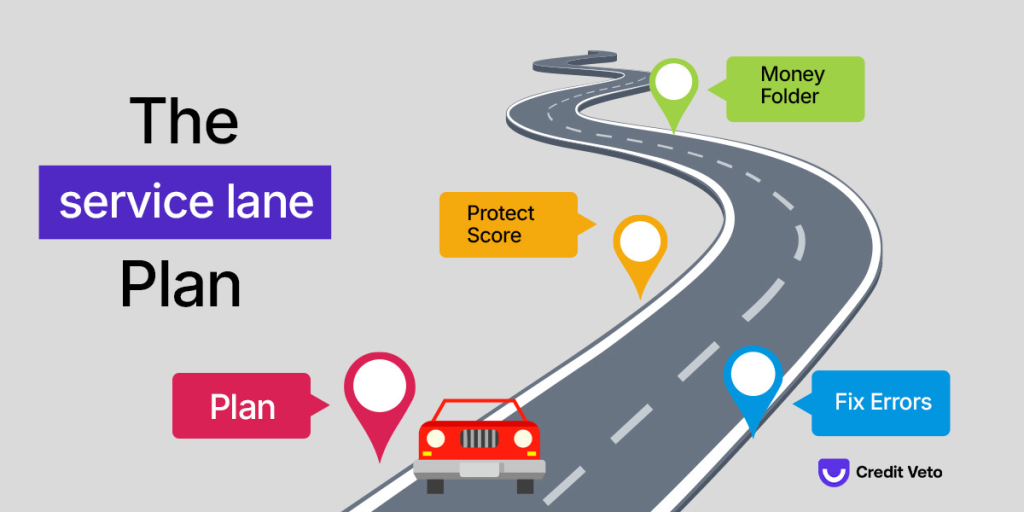
    The “Service Lane” Plan (four pit stops)

    Think of this like a service lane with four quick stops to get the buyer ready to try again.

    Pit Stop 1: Permission and a Plain Plan

    Explain what you’ll do, in simple words: check for real mistakes on their credit reports, help protect the score while those get reviewed, collect the right papers, and try again. Get the buyer’s OK to look at their reports and documents. No pressure. No promises. Just in case they don’t, you can also let them know the right credit score they need to buy a car in the U.S today.

    Why this helps dealers: Many shoppers ask about “auto fix credit” or “car fix credit” after a denial. A short, written plan builds trust and keeps them in your funnel rather than wandering off to a competitor. It also sets the stage for rebuilding credit car loans later, when the file stabilizes and the buyer can qualify at better terms.

    Pit Stop 2: Spot and fix true report errors

    Ask the buyer to pull all three reports (Experian, Equifax, TransUnion). Circle items that are inaccurate, incomplete, outdated, or not verifiable; for example, a wrong balance or an account that isn’t theirs. Send a short, clear request to fix that one line, with simple proof attached. Credit bureaus generally have about 30 days to review and then notify the consumer of the results.

    A small payment before the statement closes can lower the balance the bureau sees. Turning on auto-pay for the minimum can prevent an accidental late mark.

    Dealer context:This is where rebuild credit card dealership workflows shine: you’re not promising deletions; you’re helping customers correct provable errors and stabilize behavior so they can responsibly access rebuilding credit car loans or your in-network financing later. The paper trail matters; every note, date, and exhibit should be saved.

    Pro Tip: Do not ask to remove accurate negatives.

    Pit Stop 3: Keep the score safe while you wait by doing these:

    • Pay at least the minimum on time.
    • Aim to keep card balances well under the limit (a small payment before the statement closes helps).
    • Pause new applications until the file is ready.

    Small habits now prevent backsliding.

    Dealer context: Shoppers often search terms like “auto fix credit” or “restoration financing” when they feel stuck. Give them simple, actionable habits that protect their score while the bureaus investigate. This is also where you can educate on utilization (reported balance vs. limit) and why one small pre-statement payment can make the reported numbers look cleaner at underwriting time.

    Pit Stop 4: Build the “money folder” and re-try

    Use a one-page funding readiness checklist so nothing is missing: ID and address, recent pay stubs or income docs, and 2–3 months of bank statements. If business funding is in view, add the Employer Identification Number (EIN) and basic business documents. When corrections (if any) are posted and the folder is complete, try again with a cleaner file.

    If the shopper is self-employed, add last year’s tax return and recent business bank statements. A neat folder means fewer back-and-forths and a faster review.

    Dealer context: A tidy “money folder” reduces friction with lenders and shortens time-to-decision. For buyers restoring a classic or pursuing repairs, position car restoration loans, auto restoration loans, or restoration financing options the right way: they still require a stable profile and complete documentation.

    Fast Desk Setup for Credit Repair for Car Dealers

    Here’s a super simple way to get started at the desk after a “no”:

    • Give a one-page handout.

      Title it: “What We Do After a Denial (4 Steps)”. It shows the plan in plain steps so the buyer isn’t confused.
    • Ask for permission (opt-in).

      Have the buyer sign a short form that says, “Yes, you can look at my credit reports and update me.”
    • Set a check-in date.

      Pick a day 3–5 weeks from now to meet or call again. That’s when you’ll look at results and papers together.
    • Make a clear note in your system (CRM).

      Tag it “After-Denial Plan.” Write one short line: what you sent, why you sent it, and when you expect an answer.

    This simple setup turns “lost” auto finance leads into a trackable list you can re-engage. It’s also how you preserve goodwill for future transactions and open the door for approved rebuilding credit car loans when the profile supports it.

    Easy Scripts You Can Use

    At the desk:

    “Today wasn’t a yes. If you want, we’ll check for real mistakes, help protect your score, and put your papers in order. Then we’ll try again with a stronger file.”

    Follow-up text:

    “Hi [Name], here’s the link to your three credit reports. We’ll only ask to fix mistakes we can prove. I’ll keep you posted on dates and next steps.”

    Tweak them to suit your particular client’s needs. For service-lane shoppers asking about car fix credit or auto restoration loans, add: “If you’re planning a repair or restoration, we’ll review options once the file is clean and the folder is complete.”

    Do / Don’ts (That Protect You and the Buyer)

    • Do keep everything in plain English and in writing.
    • Do save copies of what you sent and the responses you receive.
    • Don’t promise deletions, score jumps, or approvals.
    • Don’t dispute accurate items; fix only what’s wrong or can’t be verified.
    • Do share the official how-to so buyers understand the process. The CFPB explains disputes and timelines in simple terms.

    Dealer context: This is your compliance moat. You’re not a “miracle” shop; you’re the one who keeps things documented and ethical. That reputation pays off in reviews, referrals, and repeat business.

    Tools That Keep It Tidy (one neutral example)

    You don’t need a dozen apps. One credit repair business software tool that captures leads, sets reminders, attaches proof, and sends plain updates is enough.

    For example, platforms like Credit Veto Pro give teams lead-capture pages, one-click audits for obvious mismatches, digital onboarding, automatic reminders, and results summaries so your store can document work and keep buyers informed without disputing accurate entries.

    Dealer context: This is how you run a rebuild credit card dealership program without creating chaos—one login, one paper trail, one client portal. When the file stabilizes, your F&I team can position rebuilding credit car loans or conventional auto financing with fewer surprises.

    Ready to reapply? Quick Checklist

    • On-time payments for the last 2–3 months
    • Card balances well under limits (prefer single-digit utilization)
    • Any real errors disputed with proof (and responses saved)
    • Funding documents gathered (ID, income, bank statements, tax returns if self-employed)
    • Check-in completed; file looks stronger

    When those boxes are checked, you’ve earned another try, but this time with a cleaner story for the lender. For shoppers eyeing special projects, align expectations around car restoration loans or restoration financing: approval still follows the same rules; accurate files, stable behavior, complete documentation.

    KPIs Your Desk Can Track (so this scales)

    • Re-engagement rate on denials (count how many return with a money folder).
    • Dispute cycle completion (% with responses logged within 35–45 days).
    • Utilization improvement (buyers reporting <10% on re-try).
    • Approval lift (difference in approvals pre- vs. post-plan).
    • Time-to-funding once the file meets the checklist.

    Dealer context: Publish these wins in your internal dashboard and monthly huddles. Over time, your store will be known for responsible auto credit restoration, not promises, just process.

    Positioning Your Store (and Content) for Search

    Shoppers don’t always search for “credit help after car denial.” They search how they talk, like queries like “auto fix credit,” “car fix credit,” “rebuilding credit car loans,” “car restoration loans,” “auto restoration loans,” and “restoration financing.” Build a small content cluster on your site:

    • “Denied Today? Here’s How We Retry With a Stronger File.”
    • “What Your Lender Looks For: Utilization, On-Time, and Clean Docs”
    • “Restoring a Vehicle? What to Know About Car Restoration Loans and Credit”
    • “Small Payments, Big Differences: Why Statement Timing Matters”

    Interlink these pieces and your main Credit Repair for Car Dealers page. Add a simple FAQ to each, and you’ll capture long-tail traffic from motivated local shoppers.

    Real-World Dialogue That Converts (and Stays Compliant)

    Buyer: “Can you remove this late mark?”

    Your Team: “If it’s accurate, we won’t dispute it. If it’s wrong, we’ll send proof and ask for a correction. Meanwhile, we’ll help you protect the score while the bureau reviews. When the file is clean and your folder’s ready, we’ll try again.”

    Buyer: “I just want auto fix credit to get this car.”

    Your Team: “Let’s follow the four pit stops. You’ll have a clear date to re-try and a stronger file to support your next application.”

    Buyer: “Do you offer restoration financing?”

    Your Team: “We can review options when the file is stable. The same steps (accuracy, low utilization, and complete documents) help you qualify for auto restoration loans as well.”

    Conclusion

    Dealers don’t need magic to turn more denials into funded deals. You need a simple, fair plan, a clear paper trail, and small buyer habits that compound. The four pit stops work because they’re ethical, repeatable, and easy to explain.

    If you want to operationalize this in your store—scripts, handouts, timelines, client portal, dispute guardrails, and dashboards, Credit Veto Pro was built for exactly this. 

    Next step: Book a strategy call with Credit Veto Pro. See how dealerships use our dual-service operating system to re-engage denials, document every step, and convert clean files into funded customers, without hype or risky promises.

    FAQs (People Also Ask)

    • What should a dealer do right after an auto finance denial?

    Give a one-page plan, get permission to review reports, set a check-in date (3–5 weeks), and start the four pit stops. Tag the record in your CRM as “After-Denial Plan.”

    • Can dealers help customers remove negative items?

    Dealers (or their partnered services) should only correct inaccuracies; wrong dates, balances, duplicates, or accounts that aren’t the buyer’s. Do not dispute accurate, verifiable items. The goal is a clean, accurate file and stable behavior.

    • How long do bureau investigations take?

    Typically 30 days (up to 45 if new information is provided mid-investigation). Set your re-try check-in for 3–5 weeks to review outcomes and update the money folder.

    • Do “small payments” really help before re-trying finance?

    Yes. Bureaus see statement-date balances. A small payment before the statement cuts can reduce reported utilization and help the profile look cleaner at underwriting.

    • What’s the “money folder” for auto approvals?

    ID + address, recent pay stubs or income docs, 2–3 months bank statements, and (if self-employed) last year’s tax return + recent business bank statements. It reduces back-and-forth and speeds decisions.

    • Do you handle restoration financing or car restoration loans?

    Once the file is stable, your finance desk can discuss restoration financing, auto restoration loans, or standard auto options. The same rules apply: accurate files, low utilization, complete documents.

    • How do I position my store for search traffic on credit topics?

    Publish helpful explainers using natural phrases shoppers type (auto fix credit, car fix credit, rebuilding credit car loans, car restoration loans)and interlink them. Add FAQs and localize titles.

    • Is this compliant?

    Yes—when you operate ethically: plain English, written permission, inaccuracies-only disputes, documented timelines, and no promises of outcomes. Keep a clean paper trail and use a portal.

    • What software keeps this organized for dealerships?

    An all-in-one platform like Credit Veto Pro: lead capture, digital onboarding, guided inaccuracies-only disputes, portal updates, SLA timers, and dashboards, so your team can re-engage denials and convert clean files into funded deals.

  • Credit Repair for Realtors & Business Funding (New Dual-Revenue Workflow)

    Credit Repair for Realtors & Business Funding (New Dual-Revenue Workflow)

    Short answer: Many buyers fall out due to credit inaccuracies or a lack of capital. Pairing credit repair for realtors with business funding for real estate inside one documented workflow turns today’s “not yet” into tomorrow’s closing, without hype or guarantees.

    Do you know that thousands of real estate agents lose many qualified buyers to credit issues or a lack of capital annually? But then, an education-first, documented approach (credit repair for realtors paired with business funding for real estate) can turn today’s “not yet” into tomorrow’s closing, without hype or guarantees.

    This article shows realtors and brokers how to manage credit accuracy and funding readiness in one trackable, audit-ready system.

    Why Pair Credit Repair With Business Funding?

    A curious lady with a credit card in one hand and phone in another wondering what the JPMCB Card Services on her Credit Report really mean

    A buyer who is denied often needs two things:

    1. Accurate credit reporting
    2. A plan to access capital when appropriate.

    Treating these as separate, uncoordinated services creates delays and lost trust. A unified workflow lets agents track progress, set expectations, and reengage prospects when they’re truly ready (helping teams scale a credit repair business capability alongside their core practice).

    A Second-Chance Framework for Real Estate Agents

    Digital flowchart of a second chance pipeline

    In the competitive world of real estate, many potential buyers are lost due to credit issues. But with a clear, easy-to-follow pipeline, you can help these buyers and turn them into clients. By combining credit repair and funding help, you can make sure no opportunity goes to waste.

    Here’s how you can set up your second-chance framework:

    • Stage 1: Intake & Consent

    First, gather the necessary client information and ask for permission to review and help fix their credit. This keeps everything clear and honest right from the start in a clear and honest way.

    Add-on detail: Capture consent digitally, confirm identity (KYC), and record the buyer’s objective (home purchase timeline, price band). For real estate agent bad credit cases, validate which issues are inaccurate versus accurate but improvable (e.g., utilization).

    • Stage 2: Evidence-Based Credit Review

    Next, check the credit report to find any mistakes or things that can be fixed. Identify exactly what needs to be corrected, and make sure everything is clearly written down.

    Add-on detail: Tie each dispute item to exhibits (statements, letters, identity docs). Mark the Date of first delinquency (DOFD) and create a round plan. Do not dispute accurate, verifiable data; document it and coach the client on behavior changes (on-time streaks, lowering revolving balances).

    • Stage 3: Dispute & Timeline Tracking

    Send out the requests for corrections and keep track of when they are due for a response. Make sure to mark the dates when you expect results so you can follow up in time.

    Add-on detail: Use SLA timers for bureau reinvestigations, log tracking numbers or e-notary confirmations, and post status in the client portal (“Round started,” “Awaiting responses,” “Results posted”).

    • Stage 4: Funding-Readiness Checklist

    Once the credit is fixed, gather the documents needed for business funding. Show the client how to get ready for a loan or other financial support by explaining what needs to be done.

    Add-on detail: Build a short list by product type, such as bank statements, proof of income, entity docs if applicable, and purchase intent. Route to business funding for real estate options (lines, loans) as appropriate, or coach for mortgage pre-qualification if that is the end goal.

    • Stage 5: Re-Engage for the Transaction

    Finally, after everything is in order, go back to the client and offer them a chance to move forward. Let them know what’s been fixed and how they can now move toward getting the funding or house they want.

    Add-on detail: Share a results one-pager (what changed, what didn’t, next steps). Book the buyer with your lender or your funding partner, and update your pipeline to track contract-ready milestones.

    This framework makes it easy for real estate agents to help clients who might have been turned down before. It’s all about providing a clear path that combines credit repair and funding help, leading to successful outcomes. For consumers’ rights and dispute mechanics, see the Consumer Financial Protection Bureau’s guidance on correcting credit report errors.

    Governance That Protects Clients and Your Brand

    Snapshot of a dashboard showing the governance system that protects realtors' clients.

    When running a real estate business, especially one that handles credit repair and funding, it’s important to follow clear rules and guidelines to keep things smooth and safe for both your clients and your business.

    Just like regulated industries, creating a system of checks and balances, known as governance, will help you stay organized and maintain trust as your business grows.

    Here’s how you can set up governance for your team:

    1) Roles & Permissions (RBAC)

    Make sure that only the right people have access to the information they need. For example, someone working on intake shouldn’t have access to the same data as a credit repair specialist or someone handling client success.

    This helps ensure that your team is working with the right information, but it also protects sensitive client data. Set up access controls that limit what each role can see and do, keeping everything secure and organized.

    Add-on detail: Enforce multifactor authentication (MFA), session timeouts, and disable “everyone is admin.” For real estate agent bad credit files, limit exports to named roles only.

    2) Export Controls & Logs

    It’s important to track who is accessing what documents and when. For example, if someone downloads a credit report or a client’s personal information, make sure you can see who did it and at what time.

    Regularly reviewing these logs (weekly is a good rule of thumb) helps spot any unusual activity and ensures your data stays protected.

    Add-on detail: Flag mass exports, watermark sensitive PDFs, and keep a monthly audit report for broker oversight.

    3) Document Control

    Establish a system for naming files, organizing folders, and storing documents in a way that’s easy to manage. For example, you could use standard names for files (like “ClientName_CreditReport”) and set up folders by stages (e.g., “Intake Documents,” “Dispute Letters,” “Funding Forms”).

    Make sure to redact any personal details before sharing files with clients, especially in client portals. Additionally, make sure you have clear rules on how long documents should be kept and when they should be securely deleted to comply with privacy rules.

    Add-on detail: Encrypt at rest and in transit. The test is restored quarterly. This is essential if you want to scale credit repair business operations in a brokerage context.

    4) Quality Assurance (QA)

    Double-checking your work is key to maintaining a high level of service. Before sending anything out, make sure a second person reviews it for accuracy; this is a two-step pre-send review process.

    Additionally, regularly sample previous documents to ensure everything is consistent and on track. Having a structured QA process will help maintain high standards and build trust with your clients.

    Add-on detail: Code outcomes (corrected/deleted/verified/ follow-up) and teach agents how to explain them neutrally—no promises about deletions, default credit scores, or approvals.

    Tools That Make the Workflow Manageable

    Digital illustration of the tools that make the workflow manageable.

    When choosing credit repair business software, focus on features that streamline your workflow, like lead capture, one-click audits, digital onboarding, automated reminders, and results summaries. These tools help manage tasks efficiently and keep your process compliant.

    For example, Credit Veto Pro offers lead-capture pages, automated workflows, one-click audits, and all-in-one case management. These features allow real estate teams to track timelines, document evidence, and keep clients updated without disputing accurate entries.

    Add-on detail (selection checklist):

    • Client portal with updates and document uploads
    • SLA timers for bureau windows and follow-ups
    • Funding workflows (intake → doc checklist → lender routing → status → payouts)
    • Payments & signatures with audit logs
    • Territory options if you partner with multiple offices/zip codes

    Messaging That Respects Compliance (and Converts Better)

    • Set expectations:“We correct report inaccuracies and document timelines; results vary.”
    • Explain the “why”: Show the specific field that’s wrong and the correction requested.
    • Avoid outcome language: No promises of deletions, scores, or approvals.
    • Keep updates predictable: “Round started,” “Awaiting responses,” and “Results posted,” with what changed / what didn’t / next steps.

    This neutral, explain-the-work approach consistently outperforms hype in retention and referrals—for both credit repair for realtors and business funding for real estate programs.

    What Good Looks Like (A Quick Scorecard)

    • On-time reviews ≥ 95% (investigation windows tracked)
    • Evidence completeness ≥ 90% (each disputed item has labeled exhibits)
    • Outcome coding in every case (corrected/deleted /verified / follow-up)
    • Client-visible summaries ( one-pagers each cycle)
    • Secure handling (RBAC enforced; export logs reviewed; redactions for previews)

    Add-on: KPIs to watch in your dashboard

    • Lead → consult → program start rate for “denied” cohort
    • Time-to-readiness (credit milestones hit)
    • Funding pre-approval and approval rates
    • Re-engaged buyer conversion to contract/close

    Responsible Re-Engagement of Your Database

    digital illustration of computers displaying database

    Many CRMs hide opportunity in “Denied,” “Cold,” or “Nurture” buckets. Re-engagement should be consent-based and educational, not promotional:

    • Segment by reason (credit accuracy vs capital needs).
    • Offer a short explainer (funding-readiness or credit-accuracy), not a pitch.
    • Provide a simple opt-in for an assessment and set the next milestone date, not a hard sell.

    For example, email to the “real estate agent bad credit” cohort:

    Subject: Your path to mortgage-ready 

    Body: We’ve added a documented, no-hype path to credit accuracy and funding readiness. If you’d like a quick review and timeline, reply “READY,” and we’ll send your next two steps.

    Takeaways for Realtors

    • Treat credit accuracy and capital access as one documented workflow, not two disconnected services.
    • Adopt governance (roles, permissions, QA, document control) before volume scales.
    • Choose tooling that supports evidence handling, timelines, client updates, and audit trails.
    • Keep communications neutral and educational; let the documentation, not promises, do the convincing.

    Conclusion

    If you’re a realtor or broker, the fastest way to win back “not yet” buyers is to unify credit accuracy and funding readiness into a single, auditable workflow. 

    The second-chance framework above (intake and consent, evidence-based review, and timeline tracking, funding readiness, and clean re-engagement) lets you deliver progress without hype and convert more buyers when they’re truly eligible. 

    Pair it with governance (RBAC, export logs, QA) and the right credit repair business software, and you’ll scale credit repair business capability inside your real estate shop the right way.

    Want to operationalize this playbook fast? Credit Veto Pro is the ScaleTech platform for real estate agents, as we provide your credit repair and business funding in one compliant system. Book a 15-minute strategy call today and get started.

    FAQs (People Also Ask)

    • What is “credit repair for realtors,” exactly?

    It’s a documented, evidence-based process to correct inaccurate credit reporting (with exhibits and timelines) so buyers can progress toward mortgage-ready or funding-ready—without disputing accurate, verifiable items.

    • Can real estate agents handle business funding for real estate, too?

    Yes, if you use a compliant workflow: eligibility checks, document checklists, lender routing, and clear disclosures. Many realtors on the Credit veto pro platform run credit and funding in one system.

    • How long does credit correction take before a buyer is ready?

    Timelines vary. Bureau reinvestigations typically run on fixed windows; behavior changes (like lowering utilization) can help within 1–3 cycles. Set expectations in the portal and update with what changed / what didn’t.

    • Is this approach compliant?

    Yes—when operated correctly. Only dispute inaccuracies, maintain RBAC, keep export logs and audit trails, and avoid outcome promises (deletions, scores, approvals).

    • What software should a realtor use to scale this?

    Choose credit repair business software with a client portal, SLA timers, funding workflows, audit trails, and RBAC. Platforms like Credit Veto Pro unify both services in one pipeline.

    • How do I re-engage my denied/old leads without spamming?

    Segment by reason (credit vs capital), send a short educational note, and invite them to opt in for an assessment and milestone plan. Keep communications consent-based and value-first.

    • Will offering credit help make us seem like we promise approvals?

    Not if you message it correctly: “We correct inaccuracies and document timelines; results vary.” Focus on education and documentation, not guarantees.

    • What KPIs should I track as we scale?

    On-time reviews ≥95%, evidence completeness ≥90%, funding pre-approvals and approvals, re-engagement conversion, and closed-loop analytics (where buyers stall and why).

  • How to Scale Credit Repair Business The Right Way

    How to Scale Credit Repair Business The Right Way

    Short answer: To scale credit repair business safely and profitably, focus less on raw volume and more on governance; the structures that keep client data safe, timelines on track, and disputes lawful. That means clear roles, least-privilege permissions, disciplined QA, document control with audit trails, and software for credit repair business that bakes these controls into daily work.

    Growing a credit-repair operation is less about volume and more about governance, the structures that keep client data safe, timelines on track, and disputes lawful.

    This article outlines a practical framework to scale credit-repair businesses can use without increasing risk: clear roles, granular permissions, disciplined quality assurance (QA), and robust document control supported by audit trails.

    Table of Contents

    • Why governance decides whether a credit-repair business scales
    • Roles & responsibility design (clarity first)
    • Permissions: least-privilege by default
    • Data safety: document control, retention, and deletion
    • QA that scales: from checklists to sampling
    • Software features that enable safe scale
    • Reputation management during growth
    • Metrics that signal readiness to scale
    • 30/60/90-day implementation roadmap
    • Compliance & ethics guardrails
    • Conclusion
    • FAQs

    Why governance decides whether a credit-repair business scales

    A credit repair specialist smiling and using the proven upsell system to convert his client.

    As your team expands, cases multiply, and investigation windows stack up. Without defined responsibilities, the result is missed deadlines, inconsistent dispute quality, and preventable data-security incidents.

    A lightweight governance model (implemented before adding headcount) keeps service quality steady and protects consumer information governed by federal law and industry expectations (e.g., CROA compliance and consumer-rights obligations).

    What “governance” looks like in practice

    • Documented SOPs so every dispute follows the same steps.
    • RACI assignments (Responsible, Accountable, Consulted, Informed) for each task.
    • RBAC (role-based access control) and least-privilege permissions.
    • Audit trails and review deadlines tied to reinvestigation windows.
    • QA sampling to catch errors before they repeat at scale.

    Roles & responsibility design (clarity first)

    A scalable team starts with segregation of duties and a written statement of purpose (SOPs) for each role:

    • Intake/Onboarding: verifies identity, consent, and monitoring enrollment; confirms state eligibility and disclosures.
    • Dispute Specialist: identifies disputable items (inaccurate, incomplete, outdated, or not verifiable), assembles evidence, and drafts targeted letters.
    • QA/Compliance: reviews facts, exhibits, dates (including DOFD), and tone; confirms timeline math before sending.
    • Fulfillment Admin/VA: handles packet assembly, tracking numbers, and logging responses.
    • Client Success: communicates status updates and results summaries in plain language; sets expectations.

    Each handoff leaves a short note in the case record: what was done / what happens next. A clear RACI (Responsible-Accountable-Consulted-Informed) for every workflow step prevents duplication and gaps.

    Pro tip (keeps you fast & audit-ready): keep each role’s SOP to a single page with verbs up front and links to exact templates (e.g., “Verify DOFD → attach Exhibit A → set review date”).

    Permissions: least-privilege by default

    Access expands with headcount, so least privilege is the default. Practical controls include:

    • Role-based access (RBAC): Intake sees KYC and contracts; dispute specialists see evidence; finance sees billing; no broad “admin for all.”
    • Multi-factor authentication on all systems, session timeouts, and device policies for remote staff.
    • Export controls & logs: restrict CSV/PDF exports to named roles; log who exported what and when; review logs weekly.
    • Secret hygiene: never store full SSNs, bureau credentials, or card numbers in plain text; use masked fields and vaults.
    • Transmission rules: sensitive documents flow through a secure portal, not email attachments.

    These controls reduce both insider risk and accidental exposure while preserving workflow speed. In practice, role-based controls inside tools like your chosen platform help restrict exports and keep an audit log of who accessed or downloaded what, which is essential as headcount grows.

    For a more concrete example, Credit Veto Pro supports role permissions, export logs, and stage-based tasks while enforcing a compliance stance of not disputing accurate entries. 

    Data safety: document control, retention, and deletion

    Personally identifiable information (PII) should be treated like cash; tracked and minimized. A scalable document-management approach includes:

    • Standardized foldering & names: ClientName → YYYY-MM-DD → Round1_Disputes / Evidence / Responses / Results.
    • Retention windows: define how long contracts, disputes, tracking receipts, and bureau replies are kept; purge automatically after the window.
    • Redaction & watermarking: use redacted exhibits for client-portal previews; watermark internal copies when appropriate.
    • Backups & encryption: encrypt at rest and in transit; test restoration procedures on a schedule.
    • Vendor oversight: maintain a short list of approved tools and document their security features; record acceptance of terms and data-processing addenda.

    Suggested retention baseline (tune to your counsel):

    • Contracts & disclosures: 7 years
    • Dispute packets & bureau responses: 3–5 years
    • Mail receipts/tracking: 2 years
    • Support tickets/client messages: 2 years
    • Exports/audit logs: 1–2 year

    QA that scales: from checklists to sampling

    Quality is safeguarded by repeatable reviews rather than heroics:

    • Two-step review before sending: (1) factual basis and exhibits per item; (2) timeline validation tied to the reinvestigation window.
    • Sampling after sending: spot-check 10% of packets weekly for accuracy, tone, and proper exhibits.
    • Outcome coding: log results as corrected/deleted/verified/needs escalation; use the codes to refine future rounds, not to promise outcomes.
    • Deadline monitors: a shared dashboard flags upcoming review dates, reinsertions to watch, and any cases awaiting bureau/furnisher replies.

    Some modern credit repair business software, such as your chosen platform, also timestamps reviews and results summaries so teams can sample outcomes without promising deletions or score changes.

    If you’re comparing tools, Credit Veto Pro includes Results Summary exports, template version control, and stage-based review tasks to support this exact QA rhythm.

    Software features that enable safe scale

    Selecting the right software for a credit repair business accelerates governance. Look for:

    • Lead-capture pages & digital onboarding to document consent and disclosures. For example, platforms like Credit Veto Pro provide lead-capture pages, one-click audits, digital onboarding, automated workflows, and all-in-one case management. These are features that support least-privilege access, evidence handling, and audit trails without changing the industry’s core rule: do not dispute accurate entries.
    • One-click audits that surface status/remark conflicts, DOFD mismatches, and duplicates for the dispute specialist.
    • Automated workflows that create review tasks aligned to investigation windows and send compliant, opt-out-ready status updates.
    • All-in-one management: pipelines, document vaults, role permissions, export logs, and results summary exports in one place.

    These capabilities (common in modern credit repair business software) make it easier to scale a credit repair business without sacrificing control. Platforms marketed as credit repair software for businesses, like Credit Veto Pro, emphasize evidence handling and audit trails over volume alone.

    Reputation management during growth

    As your team scales, prospects research rigorously. Search behavior often includes brand-name queries plus “reviews” (for example, searches like “credit miracles credit repair reviews”). Sustainable credibility comes from:

    • Transparent reporting: share plain-English results summaries that show what changed and why.
    • Expectation setting: clear “no guarantees” language and CROA-safe marketing.
    • Third-party education: publish explainers on DOFD, Metro 2 fields, and reinvestigation rights.
    • Consistent NAP data: align business name, address, and phone across Google Business Profile and directories.

    Metrics that signal readiness to scale

    Leaders can monitor a small set of indicators each week:

    • On-time reviews ≥95% of cases
    • QC error rate ≤3% on sampled letters
    • Evidence completeness ≥90% (each item has labeled exhibits)
    • Export-log exceptions = 0 (unapproved bulk exports)
    • Complaint rate trending down after implementing results summaries

    When these numbers hold steady, capacity can increase without eroding trust or compliance.

    30/60/90-day implementation roadmap

    Days 0–30 (Stabilize the core)

    • Document one-page SOPs for each role; publish a RACI per workflow.
    • Turn on MFA, session timeouts, and export logging for every user.
    • Standardize folder names and retention windows; test encrypted backups.
    • Build a results summary template; pilot QA sampling at 10%.

    Days 31–60 (Instrument & automate)

    • Map each pipeline stage to a review task (reinvestigation deadlines).
    • Create one-click audit checklists for status/remarks and DOFD checks.
    • Add client update templates (“Round started,” “Waiting on bureau,” “Results posted”).
    • Start a weekly ops review: deadlines at risk, QC misses, and export-log anomalies.

    Days 61–90 (Scale with controls)

    • Raise caseload caps per specialist, then track error rate and on-time reviews.
    • Launch a basic knowledge base for the team (SOPs, templates, and tone guide).
    • Publish two education articles (DOFD basics and lawful reinvestigation) for reputation.
    • Add a quarterly security & compliance audit: least-privilege check, vendor list review, and retention purge.

    Compliance & ethics guardrails

    • Dispute only what is inaccurate, incomplete, outdated, or not verifiable.
    • No guarantees of deletions, score changes, or approvals.
    • No identity manipulation (e.g., CPNs); avoid purchased tradelines.
    • Use FDCPA-aware validation for third-party collectors; apply DOFD correctly to avoid re-aging.
    • Train often; document everything. Your audit trail is your protection.

    Conclusion

    Scaling credit repair the right way isn’t about sending more letters; it’s about strong governance. Clear roles, least-privilege permissions, disciplined QA, and tight document control let you add clients without adding chaos.

    Choose credit repair business software that reinforces these habits (lead capture, one-click audits, stage-based tasks, export logs, and results summaries), and the path to growth becomes repeatable, transparent, and compliant.

    If you’re serious about sustainable scale, sign up with Credit Veto Pro to build your rails first and accelerate faster and easier.

    FAQs

    1) How do I scale a credit repair business without sacrificing quality?

    Start with governance: one-page SOPs per role, RACI for every step, RBAC and MFA, export logs, and a QA program that samples 10% of cases weekly. Use CRM  software like Credit Veto Pro that supports audit trails and stage-based tasks.

    2) What software features matter most for a growing team?

    Look for lead-capture pages, digital onboarding, one-click audits (including status/remarks, DOFD, and duplicates), automated review tasks, client update templates, role permissions, document vaults, and results summary exports.

    3) Does disputing accurate negative items help scale?

    No. Ethical and legal practice is to dispute only inaccurate, incomplete, outdated, or not verifiable items. Trying to remove accurate data risks compliance issues and reputation damage.

    4) What’s the right caseload per Dispute Specialist?

    It varies by complexity and tooling. A practical starting cap is 15–20 active cases per specialist with a 95% on-time review target; raise caps only when QA error rates stay ≤3%.

    5) How should I handle “reviews” searches on my brand?

    Expect users to search brand + “reviews” (e.g., “credit miracles credit repair reviews”). Publish transparent case studies and results summaries; encourage platform-compliant reviews without incentives.

    6) What is DOFD and why does it matter at scale?

    Date of First Delinquency starts the 7-year reporting clock and prevents re-aging. Your SOPs should include DOFD checks in one-click audits and QA reviews.

    7) How long should I keep dispute records?

    Work with counsel, but many shops retain disputes and bureau replies 3–5 years, contracts 7 years, and export logs 1–2 years. Automate purges to reduce risk.

    8) Is business funding part of scaling a credit business?

    It can be when offered responsibly. Many operators add business funding services with clear disclosures (you’re not the lender) and suitability checks; keep records and avoid promises.

    Note: Credit Veto Pro is a B2B tech platform and training built to power credit repair businesses and top professionals to launch or scale services in credit repair and business funding for their clients, with lead-capture pages, one-click audits, digital onboarding, automated workflows, and all-in-one business management. Book a call with us today.

  • How to Become a Certified Credit Repair Specialist in 2025

    How to Become a Certified Credit Repair Specialist in 2025

    Short answer: A certified credit repair specialist is a trained, compliance-first pro who corrects inaccurate credit report data and coaches healthier habits. In 2025, you can get certified in weeks, launch a lean remote practice, and start serving clients using Credit Veto Pro’s training, automation, and lead-matching tools.

    Are you looking to enter the world of credit repair? With millions of people struggling to maintain a good credit score, there’s never been a better time to become a credit repair specialist. In fact, becoming a certified credit repair expert can not only allow you to help individuals fix their financial futures but can also help you generate a steady income.

    The credit-repair-service market grew from USD 4.68 billion in 2024 to USD 5.29 billion in 2025. It is expected to continue growing at a CAGR of 13.33%, reaching USD 9.92 billion by 2030.

    In this guide, we’ll walk you through what a credit repair specialist is, why you should consider becoming one, and how you can get certified with CreditVeto Pro, the most effective way to grow your career and business in 2025.

    Who is a Credit Repair Specialist?

    A credit repair specialist is a professional who helps individuals improve their credit scores by disputing inaccuracies on credit reports, negotiating with creditors, and educating clients on best financial practices.

    They are experts in identifying negative marks like late payments, collections, and inaccuracies that affect your credit score.

    Credit repair specialists work with credit reports, guiding clients on how to dispute errors, resolve debts, and implement strategies to boost their credit scores.

    Why Become a Credit Repair Specialist?

    The credit repair industry is booming, and with over 68% of Americans facing credit struggles, the demand for professionals in this field is higher than ever.

    In 2025, becoming a certified credit repair specialist is not only an opportunity to provide essential services, but it also opens the door to a potentially lucrative business. 

    Here’s why pursuing this career is a smart choice:

    High Demand for Services

    A credit repair specialist smiling and using the proven upsell system to convert his client.

    Millions of individuals across the U.S. are facing credit challenges that hinder their ability to secure loans, mortgages, and even jobs. With such a significant portion of the population dealing with poor credit, the demand for credit repair specialists is consistently rising. 

    This is a growing market, and businesses in the credit repair space are benefiting from the increasing number of clients in need of financial guidance and assistance. 

    As a credit repair specialist, you’ll be stepping into a role where there is a constant flow of potential clients who need help navigating and improving their credit scores.

    Low Startup Costs

    One of the biggest advantages of becoming a credit repair specialist is the low barrier to entry. Unlike traditional businesses that require expensive inventory or office space, starting a credit repair business can be done with minimal investment. 

    You can launch your credit repair services for as little as $500 or even less, which makes it an accessible option for anyone looking to start a side hustle or a full-fledged business. The cost-effective nature of the industry means you can keep overheads low while growing your client base and income.

    Work from Anywhere

    Lady on afro hairstyle with a credit card on her hand and wondering why thd/cbna is reflecting on the credit report on her PC screen

    The flexibility that comes with being a credit repair specialist is one of its biggest appeals. Whether you prefer working from the comfort of your home, a coffee shop, or while traveling, you can manage your business remotely.

    With the right tools and software, credit repair work can be done from virtually anywhere with an internet connection. This provides you with the freedom to create your own schedule, which is especially appealing for those looking for work-life balance or seeking a flexible side income.

    Plus, the digital nature of the business means that you can scale it without the limitations of a traditional brick-and-mortar office.

    Make a Difference

    Credit repair specialists don’t just fix numbers—they change lives. Helping clients improve their credit can have a profound impact on their future financial well-being.

    Whether it’s enabling a young couple to buy their first home or helping someone secure financing for a car loan, the work you do will have a real, tangible impact. 

    By assisting individuals in raising their credit scores, you empower them to achieve their financial goals. The satisfaction of knowing you’re directly contributing to someone’s success is incredibly rewarding and adds a sense of purpose to your work.

    Earn a Great Income

    A credit repair specialist happily stiring at the cash notes in his hands which he got from hi credit repair business

    For those committed to the craft, credit repair specialists can earn a substantial income. Many top credit repair specialists can make between $5K to $25K per month, depending on the number of clients they serve and the services they offer. As you build a reputation and establish a loyal client base, your income potential increases, making credit repair not only a fulfilling profession but also a financially rewarding one. Whether you’re offering one-time consultations or monthly credit monitoring and repair services, the financial opportunities in this field are considerable.

    With these compelling reasons in mind, it’s clear that becoming a credit repair specialist is not only an opportunity to help others but also to build a sustainable and profitable business that can thrive in the years to come.

    How Do I Become a Certified Credit Repair Specialist?

    A curious lady with a credit card in one hand and phone in another wondering what the JPMCB Card Services on her Credit Report really mean

    Becoming a certified credit repair specialist doesn’t require a college degree, but it does require training, knowledge, and some important steps to get started.

    Step 1: Understand the Basics of Credit Repair

    To become an effective credit repair specialist, you need to understand the basic principles of credit scoring and how credit reports work. Here are a few foundational concepts:

    • Credit Scores: Learn how FICO® scores work and what factors affect them, such as payment history, amounts owed, credit history length, credit mix, and new credit.
    • Credit Reports: Understand the three main credit bureaus (Equifax, Experian, and TransUnion) and how to read and interpret a credit report.
    • Disputing Errors: Learn how to identify errors on credit reports and the dispute process with the credit bureaus.

    Step 2: Take Training & Certification Courses

    To truly stand out in the industry and be credible, you need to be certified. Training programs teach you the ins and outs of credit repair, from reading credit reports to negotiating with creditors. Certification programs like those offered by Credit Veto offer specialized training that prepares you to handle clients effectively.

    The Credit Repair Organizations Act (CROA) mandates that businesses providing credit repair services must adhere to certain rules, so certification ensures that you stay compliant and understand the legal aspects of the industry.

    Step 3: Apply for a Business License and Insurance

    While certification is important, you also need to make sure your business is legally recognized. Register your credit repair business with the appropriate government agency in your state and acquire any necessary business licenses. If you plan on handling sensitive information, consider purchasing professional liability insurance as well.

    Step 4: Choose a Business Model

    Many credit repair specialists work independently, but there are several business models you can follow:

    • Freelance Specialist: Work with clients individually, offering one-on-one consultations and services.
    • Credit Repair Agency: Build a team of specialists and grow your business by handling multiple clients at once.
    • Affiliate or Referral-Based Business: Partner with other businesses, like realtors, mortgage brokers, and financial advisors, to generate client leads.

    Credit Veto’s Lead Matching System can help connect you with clients, making the client acquisition process easier.

    Step 5: Leverage Software and Tools

    Credit repair can be a time-consuming process, so using the right tools is essential for efficiency. Software like Credit Veto’s platform allows you to track clients, automate disputes, and manage communication with ease. The right tools help streamline processes and ensure that you’re working efficiently and legally.

    Step 6: Start Acquiring Clients

    Once you have your certifications and tools in place, it’s time to start marketing your services. Here are a few strategies to acquire clients:

    • Network with Realtors and Loan Officers: These professionals often deal with clients whose credit needs repairing, and they can refer clients to you.
    • Social Media Marketing: Build an online presence and create educational content that demonstrates your expertise.
    • Offer Free Consultations: Offering free credit consultations can attract clients who need advice and give you the opportunity to pitch your services.
    • Use Your Website: Build a professional website to showcase your services, testimonials, and educational content.

    How to Offer Credit Repair Services with Credit Veto

    If you want to take your business to the next level, partnering with Credit Veto provides the tools, resources, and support to succeed. CreditVeto offers:

    • Compliance-first dispute platform: We carefully guide inaccuracies-only workflows, document vaults, audit trails, e-notary/certified mail options, timelines, and results summaries.
    • Automated case management (CRM): Contacts, pipelines, tasks, notes, permissions, and client portal with status updates and secure file exchange.
    • Lead Matching System: Warm opportunities are routed to your pipeline based on profile and service fit.
    • Payments & billing: Quotes, subscriptions, one-time invoices, dunning, and receipts—no awkward workarounds.
    • Analytics & KPIs: Dispute throughput, SLA adherence, revenue per client, refund rate, and pipeline velocity dashboards.
    • Integrations & automations: Calendar, email, telephony, e-sign, mail vendors, accounting, and storage.
    • Funding workflows (optional): Intake → doc checklist → lender routing → application tracking → payouts, so you can deliver credit + capital when appropriate.
    • Specialist support: Access to vetted credit repair specialists, funding advisors, and compliance coaches for case reviews, tricky scenarios, and ongoing optimization.
    • Templates & SOPs: Ready-to-use scripts, checklists, onboarding packets, and results-communication templates to keep your team consistent and compliant.
    • Territory options: Protect your market and build a durable local presence (where available).

    Step 7: Track Your Progress

    Tracking your progress as a credit repair specialist is crucial for long-term success. Use reporting tools to monitor your clients’ progress, measure your business’s growth, and make necessary adjustments. The goal is to continuously improve your processes, attract more clients, and provide the best service possible.

    Frequently Asked Questions (FAQs)

    Q1: What does a credit repair specialist do?

    A credit repair specialist helps individuals improve their credit score by identifying errors on their credit report, disputing negative items, and negotiating with creditors to have accounts removed or corrected.

    Q2: How long does it take to become a certified credit repair specialist?

    It can take anywhere from a few weeks to a few months to complete a certification program, depending on the provider and the course’s depth.

    Q3: How much money can a certified credit repair specialist make?

    A certified credit repair specialist can earn anywhere from $5,000 to $25,000 per month, depending on the number of clients, the business model, and additional services offered.

    The Bottom Line

    Becoming a certified credit repair specialist in 2025 offers a rewarding opportunity to help others while growing a profitable business. Whether you choose to work independently or scale your business, the demand for credit repair services is high, and the potential for success is even higher.